"Spring drew on...and a greenness grew over those brown beds, which, freshening daily, suggested the thought that Hope traversed them at night, and left each morning brighter traces of her steps.” ~ Charlotte Brontë, Jane Eyre
After a restless night in which the great lorries parked just the other side of our boat woke and lumbered off down the road with breaks singing shrilly, we stumbled from sleep such as it was, took on water, and worked our way up the next lock.
What a difference one lock makes! Suddenly we had arrived in a world washed clean while we slept! Moored up between Waltham Town lock and the footbridge, we were the only boat on this stretch of the Lee Navigation adjacent to the Lea Valley White Water Centre. The river was clean and quiet. Birds sang, the sun promised fair weather; me and Les decided to walk into the town of Waltham Abbey to see the church of the Holy Cross and Saint Lawrence, and Waltham Abbey gardens.
.jpg) There have been five churches on the site of this church, beginning in the 7th century. Flint rubble from the original wooden church have been found under sections of the present building. Originally a simple wooden structure of two rooms would have stood here.
A burial in the floor of the original section has been radio carbon dated from 590-610 ACE (After the Common Era). With the remains were found religious artifacts.
There have been five churches on the site of this church, beginning in the 7th century. Flint rubble from the original wooden church have been found under sections of the present building. Originally a simple wooden structure of two rooms would have stood here.
A burial in the floor of the original section has been radio carbon dated from 590-610 ACE (After the Common Era). With the remains were found religious artifacts.
In the 8th century during the reign of King Offa of Mercia a Lincolnshire limestone enclosure was built around the first church. It was half the length of the current church building and served the local community as minster--a term from the 7th century which denotes an ecclesiastical or clergy community living together.
By the 11th century the church and the village of Waltham were owned by Tovi the Proud--a Danish Thegn. Tovi owned other parcels of land at Montecute in Somerset where his blacksmith dreamt about a dark crucifix buried in a hillside. A summary search of said hill found the black flint crucifix deep in the soil. Tovi wanted to haul by Ox cart to Galstonbury but the mule had other ideas and refused to go anywhere but to Waltham. The cross was installed in the church, marking a pilgrimage site for early Christians.
After Tovi's death his son amassed great debt and the lands of Waltham passed to the crown and on to Harold Godwin, Earl of Essex and Wessex. Legend has it that Harold was supposedly miraculously cured of paralysis by the black marble cross, leading him to richly endow the church. His son Harold Godwinson became Kind Harold II, rebuilding and dedicating the church in 1060. It was placed under the aegis of a Dean and a college of twelve married priests (yes Catholic and married!)
King Harold is supposed to have prayed at Waltham Abbey before proceeding to fight William of Normandy at the Battle of Hastings. Harold died in battle and Will became William the Conqueror who requested the gathering of information and writing of the Domesday Book to better grasp just what he had actually won in this battle. French Normans controlled England for several hundred years after, leading to many social changes not-the-least of which was a layer of French language for officialdom and Anglo-Saxon terms for common folk.
An example of this language layering is the Anglo-Saxon cow for the barnyard animal, which was transformed to the French Norman Boef when it was slaughtered, cooked, and served on a nobleman's plate; the same holds true for sheep vs. mutton, and deer vs. venison. It was the conquered Saxon population that worked in the farmsteads, barnyards, and kitchens to serve the French Norman nobility. Oops sorry--I digress!
 |
| Harold's stone which is now located outside today's church |
Harold's body was so damaged by the battle that his concubine, the very wealthy and beautiful Edith Swanneck, was the only person who could correctly identify his remains by secret marks only she recognized, having given birth to six of his children. Harold's remains were taken by cart to Waltham and buried under the floor of the church.
Around 1090 Harold's fine church was demolished under the see of the Augustinians and the rubble was used to build a Norman style cruciform building with massive incised pillars and semicircular arches supporting a clerestory to let in light. Completed in 1150, this is the main fabric of the church which exists today.
The new church was larger than Winchester Cathedral is today--it was three times as long as it is now--a massive building with several towers, a cloisters and gate house.
In 1184 King Henry II elevated Waltham church to an Abbey, appointed an Abbott and brought the number of canons up to twenty four.
This was the panacea
offered to the Church by Henry for the murder of Archbishop of
Canterbury Thomas Becket, supposedly killed by Henry's knights after he
was heard to murmur, "Will no one relieve me of this troublesome
priest?"
Popular with royalty, Waltham Abbey enjoyed its special relationship with the succeeding lines of kings and queens who had lodges nearby and hunted in Waltham Forest, engaging in pilgrimages to the black cross of Waltham.
King Henry VIII enjoyed spending time at his lodge adjacent to the abbey where in 1532 he and Queen Ann Boleyn stayed for a week during their summer progress.
Waltham was the richest abbey in Essex and the last one in England to fall under the Act of Dissolution in March of 1540. The holy cross disappeared at this time never to be seen again.
There were several royal lodges and great houses established on grounds surrounding Waltham Abbey granted to the Earls of Warwick and Carlisle, and other minor baronetcies. Waltham manor was originally owned by King Richard I who gave it into the Abbey's keeping to be called Harold's Park.
After dissolution the manor was leased to Sir Anthony Denny, a member of the privy council and a favorite of King Henry VII. Denny died in 1549 and his widow Joan bought the manor in 1553 and it continued to pass down through the Denny line through Edward and Margaret Denny; as Earl and Countess of Norwich they made use of abbey rubble to build additions to the manor.
The monastic buildings and those parts of the church east of the crossing
were demolished at the dissolution and the Norman crossing tower and
transepts collapsed in 1553. The present-day church consists of the nave of the Norman abbey church, the 14th-century Lady Chapel and west wall, and a 16th-century west tower, added after the dissolution. The Norman remnant of the nave continued to be used as the town's parish church. In 1859 the architect William Burges was appointed to restore the abbey and its interior which is what one sees inside today.
The pictures which follow are divided into two parts: the interior of the Church and the exterior and abbey grounds which are just as breathtaking.
THE CHURCH OF THE CROSS AND SAINT LAWRENCE:
The back wall of the church today, with the semi circular mark in the grass where the oldest wall was originally standing. Harold's tomb stone there marking the old high altar.
.jpg)
One can see the layers of stone from previous incarnations of the church all layered like a cake which eventually was finished in 1150, partially destroyed after the Act of Dissolution, rebuilt and partially destroyed by the WWII blitz, it stands today a testament of beauty, passion, determination, and religious faith. The figure on the upper right is King Harold Godwinson.
.jpg)
Above, the details of the layers of stone foundations and the front door welcoming us inside.
Clerestory arches lead the eye upward as do the lovely carved stone arches with incised decorations supporting an amazing ceiling illustrating the signs of the zodiac, the four seasons, and activities such as plowing, harvesting, etc. painted by Edward Poynter.
Below, the magnificent stained glass rose window on the East wall above the high altar. It depicts the days of creation as given in the Bible.
Close up of the lancet stained glass windows below the rose window in the East wall.
The current high altar with its beautiful rose marble lower wall section, above which the reredo (wall carving) depicting the birth of Jesus and the flight into Egypt. It is capped by a carved frieze illustrating Aesop's fables.
A very old grave stone for a 13th century church Abbott.
Les sitting in a pew, taking in the atmosphere! In the 13th century a hand printed Bible was chained to one of these pillars.
The carved alabaster effigy of Sir Edward Denny in full armor, with his wife Margaret, one of Queen Elizabeth's maids of honor; with their ten children below. The girl reaching out to her sister in front signifies they were twins. Denny made his name putting down Irish rebellion for Queen Liz but he made his fortune as a privateer--a state authorized pirate! He served as an MP and worked for a time as a sheriff in Kerry, Ireland, having been given land in Tralee for services to the Crown.

This fifteenth century wax Doom painting was uncovered on a wall of the Lady Chapel. Christ floats in the center with the saved rejoicing as they enter heaven on the left while the damned tremble their way to hell on the right. This church is a stunning example of how art was used to communicate Biblical lessons to the common people who could not read. Most churches in the 12th-16th centuries were covered in paintings and sculptural admonitions which served as a vivid reminder of what happened if one stepped out of line and misbehaved.
Close up of a carved 14th century screen with "verie olde" graffiti engraved into it.
The stone masons left their signatures in a series of whimsical faces which they placed in strategic locations as they went about their work. These faces peep out as one sits in contemplation.
THE ABBEY GROUNDS:
While standing at King Harold's grave stone I noticed across the grass, the marking of a square foundation and a gated doorway in the far wall! What is it? Of course Frances Hodgson Burnett's Secret Garden comes to mind.
Actually the square foundation lines mark the cloisters which is a rectangular open space surrounded by covered walks or open galleries with open arcades on the inner side, running along the walls of buildings and forming a quadrangle. The attachment of a cloister to a church usually indicates that it is (or once was) part of a monastic foundation, forming an architectural barrier separating the world of the monks from that of the serfs and workmen, whose lives and works went on outside and around the cloister.

.jpg) What became known as the Midnight Chapel is actually the entrance to
the cloisters, part of the 12th century Abbey. In the 1830's the Abbey
farm used it to store potatoes. It is thought the Denny family also used
it for root vegetable storage. The blocked remnants of a stairway still
exist beside the doorway on the upper left. The monks would have come
from their dormers, down the stairs and through the passageway to the
cloisters and into the church for midnight prayers. The vaulted ceiling
is a fine sample of 12th century Gothic architecture.
What became known as the Midnight Chapel is actually the entrance to
the cloisters, part of the 12th century Abbey. In the 1830's the Abbey
farm used it to store potatoes. It is thought the Denny family also used
it for root vegetable storage. The blocked remnants of a stairway still
exist beside the doorway on the upper left. The monks would have come
from their dormers, down the stairs and through the passageway to the
cloisters and into the church for midnight prayers. The vaulted ceiling
is a fine sample of 12th century Gothic architecture.
This wall is what remains of the Abbey which was pulled down and used to build Abbey House--the Denny family manor. The niche in the wall to the left was the fireplace. The cloisters would have been just through the door in the wall. The gated cloister entrance is out of site to the far right.
This is the other side of the Abbey/manor wall with its bricked up windows. It beckons us onward to discover the very generous expanse of garden space just out of site.
 Dear Sir wanders ahead of me through the bright blue garden portal marked with constellations.
Oh! It is like stepping into a kind of paradise with long linear walkways where scented shrubs of lavender reach out and brush one's legs, releasing their scent as we pass.
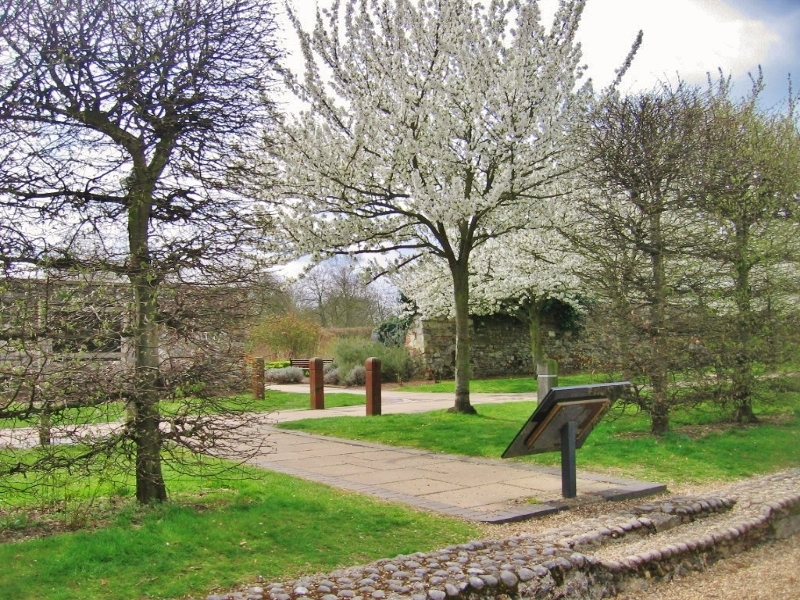
Spring flowering trees are hung with waxy pink blossoms, miniature leaves ruffling their winter browned twigs.
It is a glorious English spring day and I feel as though my soul has been offered respite from the world amongst the Abbey ruins.
Dear Sir wanders ahead of me through the bright blue garden portal marked with constellations.
Oh! It is like stepping into a kind of paradise with long linear walkways where scented shrubs of lavender reach out and brush one's legs, releasing their scent as we pass.
Spring flowering trees are hung with waxy pink blossoms, miniature leaves ruffling their winter browned twigs.
It is a glorious English spring day and I feel as though my soul has been offered respite from the world amongst the Abbey ruins.

The sun warmed stones beckon us onward to yet another vista just out of site...

...and spring's blushing beauty plays hide and seek with us through the gaps in the Abbey walls.
My heart swells with joy as Rosemary blossoms scent the air with remembrance!
Walkways turn suddenly and the view behind changes as easily as the view ahead!
Dainty shade makes patterns at our feet while above our heads...
 ...trees dance in tulle skirts made of paper white petals. Shy English daisies carpet the grassy fringe and bird song fills the air. My best beloved stops to sit under the spring white canopy while I spin round with my arms out like a child's top.
Laughter spills from my lungs as I look on in awe at the world made fresh and new once more. Spring magic harbors within it the seeds of satisfaction to be gained over the coming summer.
I let my feet go free to roam where they will, following a path I know has been trodden by countless pilgrims before me. I am seduced by spring's lush over-the-top beauty, throwing birds into a mating frenzy and bees buzzing amongst the flowers, bumbling drunk on pollen. Even the air smells brand new--never used.
An L turn in the path leads me to an astounding place, stealing my breath in wonder...
...trees dance in tulle skirts made of paper white petals. Shy English daisies carpet the grassy fringe and bird song fills the air. My best beloved stops to sit under the spring white canopy while I spin round with my arms out like a child's top.
Laughter spills from my lungs as I look on in awe at the world made fresh and new once more. Spring magic harbors within it the seeds of satisfaction to be gained over the coming summer.
I let my feet go free to roam where they will, following a path I know has been trodden by countless pilgrims before me. I am seduced by spring's lush over-the-top beauty, throwing birds into a mating frenzy and bees buzzing amongst the flowers, bumbling drunk on pollen. Even the air smells brand new--never used.
An L turn in the path leads me to an astounding place, stealing my breath in wonder...

 Beyond the blossom walk I spy the Abbey's old forge, enclosed in walls of espaliered trees!
 What a fabulous idea! Small stones shift under my feet as I tread across the open floor, examining the round well head and adjacent fire pit. I close my eyes and listen....the present fades and the past becomes the immediate moment. I hear the repetitive clang of the blacksmith's hammer and the nicker of horses waiting to be shod. Monks murmur in the sun beyond the forge's shade. The smell of sweat--animal and human--fills my nose and a heat shimmering haze moves behind my eyes. The sudden encounter of hot metal with cold water fills the forge with the SSSSSSSSSsound of steam rising, filling my chest, carrying the tang of hot iron inside me.
Les calls to me and I return to my own moment in time, my eyes opening to the present. It is time to go...
Back on the path again I venture a look back at the bloomery forge as it is named now. When the espaliered trees leaf out and bloom it will be a child's paradise--an outdoor room the witch in me wishes could be utilized as ritual space. Think of the energy one could raise in such a place under the brilliant light of a spring full moon!
As the espaliered walk grows smaller behind me, we go back through the scented garden and out the other side to a large grassy field. The church sits snugly in the landscape as it has for nearly a thousand years in one incarnation or another awaiting the footfalls of the faithful.
What a fabulous idea! Small stones shift under my feet as I tread across the open floor, examining the round well head and adjacent fire pit. I close my eyes and listen....the present fades and the past becomes the immediate moment. I hear the repetitive clang of the blacksmith's hammer and the nicker of horses waiting to be shod. Monks murmur in the sun beyond the forge's shade. The smell of sweat--animal and human--fills my nose and a heat shimmering haze moves behind my eyes. The sudden encounter of hot metal with cold water fills the forge with the SSSSSSSSSsound of steam rising, filling my chest, carrying the tang of hot iron inside me.
Les calls to me and I return to my own moment in time, my eyes opening to the present. It is time to go...
Back on the path again I venture a look back at the bloomery forge as it is named now. When the espaliered trees leaf out and bloom it will be a child's paradise--an outdoor room the witch in me wishes could be utilized as ritual space. Think of the energy one could raise in such a place under the brilliant light of a spring full moon!
As the espaliered walk grows smaller behind me, we go back through the scented garden and out the other side to a large grassy field. The church sits snugly in the landscape as it has for nearly a thousand years in one incarnation or another awaiting the footfalls of the faithful.

We turn and walk down another path through a drowsy dream towards the gate posts in the Abbey wall and beyond...
...through the gap in the shrubbery and back to hustle and bustle of the 21st century.


 Now this looks pretty tranquil i hear you saying. We have just exited a lock and have moved past the lock mooring in fact are moored just in front of our friends Jacquie and Stein on Like Ducks 2 Water. This was the first time we had caught up with them on these waters. So back to the mooring. What you can`t hear in a picture is the main road that is just behind the trees on the left. Also because the water is so shallow on the mooring we have a continuous crunching as the bottom is sitting on stones. Just ahead around the bend the bank reverts to as pictured above and the road comes out of hiding from behind the trees so you can watch and listen to those trucks as they roar past.
 Aaaah! here we go Sawbridgeworth town visitor moorings. Quite handy next to the road and trucks passing...so it should be peaceful not. Perhaps if we move along the mooring the road might curve away, after all I can`t see any other boats so we can choose our spot.


 The plane problem is the close proximity of Stanstead Airport. It seemed that for a long section of the Stort we were either near the take off or landing flight paths. So you move away and the planes seem to have disappeared but suddenly they appear from a completely different direction, I assume it`s a change of wind direction forcing a change of approach. Trains are never far away and can be tolerated at a distance but the sound of their two tone horns is a bit annoying. The train tracks are crossed in many places by small access tracks or footpaths and the approaching trains have to blast a warning.


.jpg)

.jpg&container=blogger&gadget=a&rewriteMime=image%2F*)


.jpg)