How to Leave a Comment on Our Blog

HOW TO LEAVE A COMMENT ON THIS BLOG
1. Scroll to the end of the post.
2. Click on the phrase "0 comments" or, if there are comments it will indicate how many, for example, "8 comments." Clicking on this will open the comment option for you.
3. Type in your note.
4. Choose your Profile. If you don't understand the choices under Profile then choose Anonymous but PLEASE type your name and location at the bottom of your comment so I know who you are!

Monday, April 16, 2012

An Answer for Bryce--One of our readers

"Curiosity killed the cat; satisfaction brought it back!" ~Anon.

Bryce from Canada commented on a previous blog post with many good questions commonly asked by non-boaters, so I thought I would take his email and answer it here in a post. That way I can share the answers with anyone else reading the blog who may have similar questions.

Some questions, then...Q. Photographically speaking what are you/Les utilizing for a photographic device?
 A. Les gave me my first digital camera: a Canon 520. His is newer but very basic. We use Microsoft Office 2010 Picture Manager to edit and re size our pictures.

Q. The ingredients in the foods for say visitors who drop in (float in?) from seemingly nowhere. When you lived in Pullman, as much as here you went to the chest or upright freezer, pulled something out and then thawed same and warmed it or cooked it. With no visible freezer on board your NB and a very small (compared to North America refrigerator how do you manage to produced such delectable and a fattening meals and cakes and the like?

A. Even Les stands in awe (and terror) of how much I can squirrel away in the limited space available. He refuses to open the fridge and look inside anymore. It is intensely packed and he cannot find anything whereas I know where everything is located.
Les was kind enough to add little storage shelves in nooks and crannies and we are very good at making use of practically every bit of space we can.
I worked for awhile as a pastry chef at a lodge in Alaska. My mother was also a cook--she was part owner in a restaurant before I was born and she also managed a school cafeteria, so I learned a from here about how to store things.
I also had a catering business of my own and have prepared meals for as many as 60 people at a time, so I have a very good idea of how to get the most out of the least. I re-wrap all meat once we return from the store. I mix meatloaf and then freeze the mince--as they call ground beef over here. I also mix and shape hamburgers and wrap and freeze them individually. Easy to thaw and cook, and I can work them into the nooks and crannies in the freezer!
I use evaporated milk most of the time for cooking because it provides richness in taste and is easy to store.
Les' first and first rate Raspberry Bakewell Tart!
   I spent three hours every evening after work for the entire month of January 2011 building a new recipe book for my life over here. I've subscribed to Fine Cooking magazine for fifteen years. No way I could bring all those with me, so I cut out the best of the best and pasted the recipes in my new hard bound book. I also copied all my old tried and true recipes from my old, tattered spiral bound recipe books.
   Under my expert tutelage Les is even learnng to bake from scratch. Here is his first attempt at a Raspberry Bakewell tart--and it is much better than the one I made!!
Q. Do you have problems on the boats with what we call house flies (have you tried a traditional fly swatter instead of the fun?), spiders, cockroaches, ants and similar?
A. Oh yes indeedy we do. Our boat does not have screened windows or doors. We each have our own personal flyswatters and we vie for who is the fastest and most accurate swatter.
I have arachnophobia and spiders love to hitch a ride on the boat. I think the majority come from the fire wood we store on the roof. Les is now used to my hysterical shrieks accompanied by a dance that resembles the mashed potato, jitter bugging, and the hokey pokey.
    When I first moved on board and encountered a spider my hysterical antics nearly gave Dear sir a heart attack--now he just finds the eight legged menace, scoops them up in his hand and either releases them outside (yes--my thought exactly--so they can find their way back in again to torment me) or he squishes them.
   I found a product at a chandlers called No More Spiders and I am eager to try it out. The directions say, "It creates a natural border preventing spiders form wishing to enter one's home. Consisting of natural extracts of chestnut and clover leaf oil, it deters spiders but doesn't harm them. just spray around doors, windows and any areas spiders use to gain entry to one's home. Reapply every time you clean or every 2-3 weeks."

Q. And a report came over the airwaves that a substantial fine would be imposed if anyone was found to be using a hose for watering the garden anywhere (the UK calls them hose pipes) due to the lack of water just about anywhere. Will this affect boaters?
A. This ban does not affect boaters. Please visit NB Yarwood's website for more in depth information.

   Oh and Les didn't enjoy the summer heat you had for in Pullman, something here in Southern Ontario which is common in the summer ie 30 to 35 degrees in the summer, on a regular basis. Seems we either have a cold weather alert in the winter OR a high heat alert in the summer.
    You are correct about Les hating the high temperatures of Eastern Washington summers. He was not alone. As an Alaskan born and bred I too hated those miserable hot summers.
I love the weather here so far. Any place that requires me to consider slipping on a sweater in summer is fine by me!

Q. As an aside how do you handle money? Is there a central postal drop point for letters and such? Do you have a bank account where? How is money handled, obtained when living on a NB? Assume what we call AT M's abound however the home or base account is where?
A. Finances are similar here as they are in North America. We have debit bank cards which we use for most items. If we are going to purchase coal or diesel from a working coal/diesel boat then we try to find an ATM at a nearby town and have cash in hand. They too live on their boats and work on them as well so it is easier for them to be paid in cash. We have wireless Internet and everything that can be electronic--monthly account statements, etc. are available online.
    We use Les' son and daughter-in-law's address as a permanent land based mail address which is essential for certain things over here, however we are now a long way north of Luton which is back south about thirty five miles outside London. Occasionally Kev and Joanne post us a large package of mail which has piled up for us--boating magazines, fliers, catalogs, etc. via Post Restante.
      Does Canada have general delivery for mail? In the States if one lives in the boondocks, the Bush, or the end of the known world, then it is possible to receive mail addressed to you at that post office address and "General Delivery." This way the Post master of that station knows you don't have a box and they will hold any and all mail addressed to you until you collect it.
Here in the U.K. there is a system called Post Restante. We have a set of books called The First Mate's Guides and they deal with finding services in local villages and towns on respective canals.
    We check the First Mate's guide for some place near us with a post office and we call the post master or mistress to inquire as to whether or not they will accept mail Post Restante. If they say yes, we give them our names, explain who we are, and ask them to expect mail addressed for us in the next week or so.
    It works brilliantly and allows us to keep traveling along and still receive letters and packages. We just have to calculate how long it will take us to get from wherever we are now--to wherever the post office is located.

Q. Ditto other of life's requirements Medical care (National scheme as here, no doubt but is there a floating doctor setup?)
A. Not to my knowledge and this is where things get sketchy for me as an American who is used to the requirement of paying for health insurance through an employer or paying for medical treatment--or both. Part of having a permanent land based address in teh U.K. is registering in that area with a physician.
    As one travels one is supposed to explain one's circumstances to the clinic or hospital in the area near where on is actually located on the boat and still get assistance. My experience recently in Whitchurch left much to be desired and left me totally unimpressed with nurses and doctors, and the system in the UK.
   It was however a small village and Les assures me a visit to the hospital in Shrewsbury will be a different story as it is a large town and its hospital is set up to cope with accidents and injuries of strangers who do not reside locally.
    Any of you other boaters living aboard and CC'ing may chime in on this issue with your wisdom and experience any time for the benefit of both Bryce and me. I am a medicinal herbalist and buy what I need and have it sent to me or wild craft what I need from along the towpath.
Q. And how has Jaq adopted to living in a different country/world versus a set not moving home?
A. I am really happy here Bryce. Les is the kind of man I didn't believe existed. We are very well suited for one another and delight in each other's company. We both love the waterways and living aboard a narrow boat. It won't suit everyone but it does suit us.
   I love it when we up sticks as they say and cruise along. Les gets a certain look on his face--think of a dog that LOVES to stick its face out the window into the wind as the car roars along (only Les is much better looking and doesn't make large lip faces!) and I love seeing new scenery and something fresh around every turn. 
   Then, after a day or two cruising along we will moor up for a few days, settle in and explore an area while planning our next moves. 
   We keep an eye our for fresh firewood, new lambs and baby ducks and geese, waterfowl in general, buzzards, and all manner of wild life. I saw my first Munt Jac deer back near Napton. 
   Boat people are wonderful. There is a real sense of community here. One gets to know the other boaters from their blogs and from meeting them at locks, swing bridges, on the bus to town for groceries and at the local canal side pub, and of course--whenever we run into boaters we know heading in our direction, we might moor up for hte night nearby and visit for a cuppa and some cake, or a natter to catch up. Folks look out for one another from all across the system. 
   Yes, there are things I miss about life in the States--especially my children, grandchildren and dear friends; I miss Hidden Valley Ranch salad dressing mix, Lipton Onion Soup mix, Gulden's spicy mustard, Graham cracker crumbs, Saltine crackers, decent dill pickles and bread and butter pickles, sweet 
italian sausage, root beer floats, Fontina cheese, Pepper jack cheese, Havarti cheese, and the multitude of chile choices such as Anaheim, Ancho, Poblano, and corn tortillas--but they are small things indeed by comparison to the things--and people I've gained as a result of becoming an ex-pat.
   There you are then Bryce. Thank you for your questions and I hope I've answered them thoroughly.

Cheers!
Jaqueline

Saturday, April 14, 2012

Lifting the bridge to Marbury

This is Wrenbury Church lift bridge and the first one Jaq has raised since her life on the canals began. I kind of hoped she would enjoy the experience as there are a few more before we reach Llangollen and the same on the return journey.
 All is well as I zoom in on her lovely face, the camera tells all, look at that grin. That my friends is the face of a happy woman. The next bridge just a short distance further carries a road across the canal and is electrically operated. Jaq has already conquered this type down south.
This is the parish church of St. Michael and All Angels at Marbury village and can be accessed via the lane from Marbury lock. The church is mentioned back in 1292 but at this time had no tower.                The tower was added in the 1500`s and if you think the tower looks odd in the picture it`s because it is 25" out of vertical. Back in the late 1990`s bore holes were made around the church to a depth of  between 30 and 80 feet. It was found the church sat on mainly sand of different types some being loose and compressible resulting in the subsidence below the church.
For those in the U.S.
we are able to take pictures inside these village churches as they are quite often left open and un-supervised. Recently lead to the value of £10.000 ($15.000) was removed from the
roof during the night. This theft could result in higher security and churches being locked at times that services are not taking place. This would be a great shame for those of us who like to sit and wonder at the craftsmanship that went into the creation of these buildings.
.


At the rear the church looks down across one of many Meres in this area that were formed 10-15,000 years ago at the end of the ice age. The field that leads down to the Mere from the church is in mid May to be the site of the Marbury Merry Days. Having attended the event some 3yrs ago I can tell you it is quite a fantastic show.Link to my post at the time is HERE.

Thursday, April 12, 2012

Looking back: A Pictorial visit to Brewood Part I

t   We visited Brewood in mid February. I am looking back and attempting to catch up so our blog is more timely. It is hard to find time between traveling to new places so frequently, working online instructing my courses, and the activities of daily living such as cooking, cleaning, and laundry. My days are not dull and I find myself surprised by how quickly each one fills up.
   Here then is a two part pictorial journey to and through Brewood. I designed these posts mainly for Americans who have never been on a narrow boat or traveled along a canal, and for those folks who have never lived aboard or continuously cruised.

Extracts from A Corner of Old England James Penderel Brodhurst,

                                     May 12th 1883. (www.brewoodvillage.org.uk)

old picture   “Within 130 miles of London there surely cannot be another spot where the England of the day before yesterday can be studied so perfectly. Brewood consist of half a dozen streets and a market place. Every street contains something interesting to the rambler in this forgotten town.
   It enjoys the title of town by reason of the market which was granted to its men by Henry II six hundred and sixty two years ago. The market has disappeared this hundred years, but the lazy, dreamy life of the old place goes on as always.
   The annual wake is the one excitement of the year, and then there is the brave gathering of the clans from the country round and from over the little river Penk, which is the natural boundary between Stafford and Salop.”
   The Famous Brewood Wake, which was held in Medieval times to commemorate St. Mary’s birthday on the Sunday nearest September 8th, is still held, albeit every four years.
Market Square    Although the population has expanded, Brewood retains its original character and has been designed a conservation area. There is an abundance of listed buildings: half-timbered old houses and cottages in the traditional black and white style, alongside dignified houses of the Georgian and Queen Anne period. It is difficult to isolate any for special mention, but Dean Street is particularly appealing, providing a very attractive setting for the Parish church of Saint Mary the Virgin, and Saint Chad." (Accessed online 04/12/12).
   The Norman Domesday Book documented the village as 'Breude'. The name is probably a compound made up of a Celtic, Brythonic word with an Anglo Saxon, Old English word.[1] The first element is the British word 'briga', which appears in modern Welsh as 'bre'. This is the most common of a number of Celtic place-name elements signifying a hill.[2] It appears in various combinations, but sometimes on its own, as in Bray. Margaret Gelling, a specialist in West Midland toponyms, suggested that it was often misunderstood by the Anglo-Saxons as a name rather than as a common noun. So they thought they had come upon a place called by the natives Brig or Bre, rather than simply a hill. This is why the word is often combined tautologically, as in Breedon on the Hill, where all three elements have the same meaning.
The second element is probably obvious: the Anglo-Saxon 'wudu', signifying a wood. Hence the name Brewood means either "Wood on or by a hill" or "Wood near a place called Bre". (Wikipedia, accessed 04/12/12).
   The old Roman road, Watling Street, (now the A5 trunk road) runs one mile to the north of the village. There were small Roman stations along this route... however...the history of Brewood really begins with the Anglo-Saxon settlement, when it emerged as a village within Mercia.
   The place name suggests that it came into existence during the earlier part of the Anglo-Saxon period, when there were still people in the area of Celtic language and culture. However, the first real documentation comes after the Norman conquest of England.
   At the Domesday survey, in 1086, Brewood fell within the Cuttlestone Hundred of Staffordshire. The survey records that it was held by the Bishop of Chester and that it had been a church property before 1066. However, the landholder of the manor of Brewood in the Middle Ages is generally stated to be the Diocese of Lichfield. This is not a contradiction, but reflects the shifts in the seat of the diocese.
   In 1075, Peter, bishop of Lichfield, had transferred his see to Chester, and there it remained until 1102, when it moved to Coventry. From 1228, the official title was the Diocese of Coventry and Lichfield.
   Brewood was assessed for tax purposes as 5 hides, the hide being notionally an area of 120 acres, although at this time it had become simply a unit of tax liability, irrespective of actual area. Domesday also records Brewood as consisting of enough land for 20 ploughs.
   The bishop had twenty slaves cultivating his land in the village. The rest of the population consisted of 24 villagers, 18 smallholders and a priest. There were two mills, presumably on the River Penk. There was also a substantial area of woodland, tending to confirm the accepted etymology. However Domesday records that the value of the village was £10 in 1066, and had halved in the twenty years since. Hence we can be sure that it had prospered in the late Anglo-Saxon period but had suffered a check to its growth during, and perhaps because of, Norman rule.
   Norman rule brought Forest Law to the area, and it was not until 1204, in the reign of King John, that Brewood Forest was abolished. It should be noted that a forest was a royal hunting reserve, not necessarily wooded. The area of the parish to the east of the Penk was not part of Brewood Forest, but belonged to the Forest of Cank or Cannock Chase. It was not deforested until about a century later.[4]
Shortly after deforestation, in 1221, a charter for a Friday market at Brewood was granted to the Bishop of Coventry and Lichfield suggesting considerable growth and increased prosperity since the Domesday survey.
   From the mid-12th century, two religious communities of women developed in the Brewood area. The priory of St Mary, Brewood, generally known as Blackladies, was a Benedictine house, to the west of the village. It owned land and property around Brewood, and elsewhere in Staffordshire and Shropshire. 
   There is much ancient history in and around this village worth looking into if you are a history buff.
   In 2012 Brewood is a village in revival due to the automobile which allows folks to reside in Brewood and commute to work.

   Here we  go then, part I of a pictorial journey in and around Brewood...

NB Valerie heading under Avenue Bridge 10 on the Shroppie. Look at the beautiful balustrades used on the bridge top, and stairs on the right leading up from the canal.  
Through the bridge... 
 
...and out the other side; looking back through at Chillington bridge 9 in the distance.
My first view of the village of Brewood from the canal. The church spire is a constant, seen from every place in the village. The canal sits atop an embankment offering splendid views across the fields of Brewood. See the kissing gate on the lower right which opens to a public footpath into the village?
The boat ahead of us is exiting Deans Hall bridge 12...
..through which we entered. After School bridge 13 the canal drops from an embankment overlooking Brewood into a cutting with quite steep sides. The village is up at the top. NB Valerie is moored to the right, with Brewood bridge 14 ahead.
Walking from the boat, we come back down the towpath toward School Bridge...
...and out the other side. The towpath leads on to a public footpath up the embankment. Brewood school is up on the right.
At the top of the path to the gate. The bridge is on the left, and the school is there on the right. We will turn right, walk past the school...
...and follow the small dirt lane around into the village, keeping an eye on the church spire in the distance.
Large privet hedges enclose the road, leading us onward... 
"Read the directions and directly you will be directed in the right direction.."
...to a sign which says "public footpath", and points toward a long, narrow walkway between a building and a tall hedge.
A sharp left off the dirt lane and the 21st century falls away..
...as we follow a well worn path trodden by countless feet over many, many centuries; looking back the way we came...
...and facing forward the way we are going, into an ancient, narrow warren of brick walls. The church spire directs us of toward the heart of the village.
What appears to be a proverbial brick wall to nowhere...
...actually leads on to the right and a sharp left.
And here we are! A doorway onto the sidewalks of Brewood, with the church yard adjacent. I literally felt as though I had traveled centuries back through time, as well as a mile from the canal and the comforts of our floating home.

Crossing the street from the magical doorway in time and walking up the pavement (sidewalk) brought us to this tiny police station. The church is out of sight just to the right. You can see the corner of the churchyard wall there...
...and looking back the way we've come. The main or high street of Brewood is lined with interesting little shops.
My favorite boater taking a break on our way to the Cooperative store for a few groceries.
This is the water trough and village water pump which appears in the 1800's black and white picture near the top of this post. The Cooperative food store is across the street.
on our way back now, Les leads the way..
..."this is a public footpath and it is an offense to ride motor cycles and horses beyond this point..."
Back down the long, narrow pathway...
where Dear Sir waits for me to catch up.
Les with one of our many reusable grocery bags in hand. He is standing in front of a very old hedge which blocks the view across the fields to the canal. 
Back down the lane, past the school to the bridge and back into the 21st century.
 Les walks down the public footpath...
 which connects at the bottom with the towpath on the Shroppie.

 Back under School bridge we walk..
 getting a horse's eye view of the rubbing strake which caught the friction of the rope leading the horses which used to pull the canal boats before the age of the engine. 
 Here is a close up of the gouges in the metal from the ropes!  
Home again, home again to NB Valerie.
Now my American family and friends have an idea of life on the cut. Everything we have on board must be located, procured, and carried back on foot!


Wednesday, April 11, 2012

Welcome to Wales

"Life is short. Break the rules, forgive quickly, kiss slowly, love truly, laugh uncontrollably; never regret anything that made you smile." ~Anon.

   We woke this morning in Whitchurch with sunshine pouring through fat, tall, white clouds. The BBC weather indicated "After a chilly start inland, lengthy sunny spells at first will give way to frequent heavy showers in most areas by afternoon, with a risk of hail or thunder almost anywhere..." All righty then! 
   We were ready to cruise and Ma Nature was planning a tempest. Off we went and within three swing bridges it started to rain. Squirrels hung from tree branches with their tails pulled up over them like furry umbrellas. Birds flew low, looking for shelter.
   Shortly the rain turned to hail, as we made our way toward the Prees Arm of the Llangollen canal for diesel and water. Along the towpath we were greeted by none other than Elsie from NB Bendigedig, out for a walk with their four legged family member Ben.
   After filling up the boat, dumping the rubbish and having bacon and egg salad sandwiched for lunch we turned around and headed back our of the Prees arm. The sun came out and our jackets appeared to steam as water evaporated from the heat of the sun.
   We found NB Bendigedig moored across the way so we pulled up and joined Elsie and Eric for a cup of coffee and some great chat. I've followed their blog for some time and Les has crossed paths with them several times over the years.
   While we enjoyed the warmth and friendly conversation aboard their boat, the promised thunder storm arrived, dumping a river of fat rain drops accompanied by thunder and lightening. My first British storm!
Elsie, Eric and Ben
   When the rain subsided we said our good-byes to Eric, Elsie and Ben, continuing onward.
   Shortly we cruised through the Fenn's, Whixall and Bettisfield Mosses nature reserve. Suddenly a post appeared on the towpath announcing "Wales." We quietly crossed from England into Wales. I kissed Les and thanked him for making a lifelong dream come true.
   My maternal grandmother was Welsh. She emigrated in 1918, and always wanted to return but never had the opportunity. Now I am here, and I feel like I am closing a circle which she opened ninety four years ago. How appropriate we were welcomed so warmly by Eric and Elsie, whose boat is named in Welsh and means "wonderful!"

Monday, April 09, 2012

Onto the Llangollen

Hurleston Junction and we leave the Shropshire Union and turn into the first of  4 locks lifting us 34feet up to the Llangollen Canal.
By the time we reach the Welsh town of Llangollen we would have travelled 44 miles and gone through another 17 locks rising us another 109feet.  Amongst those 17 are 3 staircase locks at Grindley brook.
A  staircase lock is 2 or more locks where the upper gate of one lock serves as the lower gate of the next.
Click HERE to see the video of Grindley staircase locks working.


So on we go the picture shows us in the 1st lock having just risen from the Shropshire Union in the picture above. Jaq is walking on to prepare the next lock while I will bring the boat forward and close the gates behind me.
The original plan was a canal linking the River Mersey via Chester and Wrexham to the River Severn at Shrewsbury. The section from the Mersey to Chester was built as was a section up to Frankton locks(now part of the Montgomery). Finance and land purchase issues stopped the original plan and the canal eventually joined the main canal system here at Hurleston in 1805 where Chester can be reached.


At bridge 6 Burland it was good to see the shop had re-opened. Locally made pies on display looked scrummy and Jaq purchased a Steak & Ale plus a Chicken & Mushroom. Highly recommend them folks.
Just a few doors past the stores this neat turntable makes for a safe exit  from a small driveway. The driver just spun the car on the turntable and reversed off ready to safely drive out instead of reversing into a quite busy road.


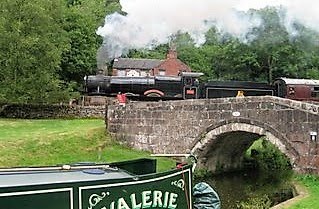
NB Valerie & Steam Train by Les Biggs

NB Valerie & Steam Train by Les Biggs