How to Leave a Comment on Our Blog

HOW TO LEAVE A COMMENT ON THIS BLOG
1. Scroll to the end of the post.
2. Click on the phrase "0 comments" or, if there are comments it will indicate how many, for example, "8 comments." Clicking on this will open the comment option for you.
3. Type in your note.
4. Choose your Profile. If you don't understand the choices under Profile then choose Anonymous but PLEASE type your name and location at the bottom of your comment so I know who you are!
Showing posts with label firewood. Show all posts

Monday, January 11, 2016

Chinook Weather


"It's true. Somewhere inside us we are all the ages we've ever been. We are the three year old who got bit by the dog. We're the 6 year old our mother lost track of at the mall. We're the 10 year old who was tickled till we wet our pant. We're the 13 year old shy kid with zits. We're the 16 year old no one asked to the prom, and  so on.  We walk around in the bodies of adults until someone presses the right button and summons up one of those kids." ~ Anonymous

     My last blog post detailed my favorite non-boating blogs. This morning I read the latest post from Idlewild, Alaska written by a homesteader named Amy. In it she writes about the word Chinook, offering several different definitions: a helicopter, a dog breed, the proper name of a Pacific Northwest coastal native tribe, and the name of the warm, strong winds that roar down off the Alaskan mountains bringing warm, wet weather, gusts with speeds up to 100 MPH, and near tropical temperatures of 40F in January! She writes,"But to me, the chinook is a winter storm in Alaska. It’s that warm southern wind that blows in and often brings rain and sometimes eventually snow with it. The winds howl at 100 mph or more. Trees blow over. Power lines are knocked out and the roads turn to wet ice rinks. Temperature will go from negative 20 F to 40 above in a matter of hours. I adore windy days because of these chinooks. To me, wind means warmth!"
     Amy's post transported me back to my Alaskan childhood and the feeling of excitement that used to vibrate through my limbs upon waking to find the Chinooks were blowing! Such a contrast to the short, brittle, freezing days when temperatures plummeted to as far as -30 F. Bear in mind that in The Last Frontier children play outside at recess until the weather officially drops below -20F. I plodded off to school in my winter gear minus snow pants. Chinook weather was a good reason to wear a dress and tights! I would anticipate the walk home in the afternoon when the winds had melted the top layer of snow on the roads, forming a mantle of water over the hard packed ice. 
     We would purposely leave our winter boots behind at school, escaping to the street in our shiny, hard bottomed dress shoes which performed like skates on the wet, slick road.  Opening our coats and holding each side out like bat wings, the ice-eating winds pushed us along--children sailing on the winter streets, giggling and laughing, playing with the weather. Of course we would get home and be in trouble; feet soggy, coat soaked, tights wet and grimy from falling, hair a-tangle and cheeks glowing with the pink kiss of the wind, but who cared! The wind, the wind, the BIG Chinooks came to play with us!
     Jump forward in time to 1980 when I was the mother of a toddler, living in a second floor apartment across the parking lot from a truss maker--a local south Anchorage company--that manufactured huge wooden roof trusses. Their yard was protected with 15 foot tall chain link fencing. In the corner of their lot nearest the road was a tall stack of industrial grade plywood sheets three inches thick, eight feet wide and twelve feet long. I remember listening to the wind rattling at the windows, watching the road ice melt into a shining, water-slick surface as the Chinooks gathered strength throughout the day. When it reached 90 plus MPH, the invisible breath of the wind lifted the sheets of plywood one-by-one, an invisible hand shuffling a giant deck of wooden cards, flicking each sheet over the top of the chain link fence with nary a struggle, sending giant wooden panels skittering down the street like toys. 
     Out in the Alaskan wilds Amy writes about taking advantage of the warm wind to split logs in preparation for the colder weather which will surely follow in the wake of the mighty Chinooks. Les and I suffered firewood envy as we drooled over her blog pictures of their wood pile. Thank you Amy for a mighty blast from the past!
Firewood during the Alaskan Chinook - IdlewildAlaska
Copyright 2016, Idlewild, Alaska

Tuesday, May 15, 2012

The Boater and the Ermine

   Decades ago when I was a young mother living in a log house in the sticks of Alaska with no Mod Cons (modern conveniences), including no refrigerator, we kept our meat and other goods that can be frozen, in a large box on the back porch. Bear in mind it is cold enough to keep things frozen outside in much of Alaska for nine months of the year.
   One dark, bitterly cold winter’s eve while we were all seated at the table eating dinner, I heard a noise on the back porch. Putting down my silverware, I cocked my head and listened closely. A very slight scratching, dragging sound came from the other side of the back door. What on earth could it be? Earlier experiences in the Alaskan bush taught me to tread carefully in a wilderness filled with wild animals—most bigger than me.
   I moved quietly, creeping to the back door, easing the handle around and carefully pulling the door open enough to peek out. Light from the kerosene lantern cracked the black night, a sliver of yellow brilliance illuminating the back porch and the mounded snow beyond.
   I peered out carefully, seeing nothing large looming in the dark beyond the door; to my astonishment the frozen food box moved slightly with scuffing, scratching mustela_erminea2sounds that echoed in the cold night air.
   Throwing open the door I caught an Ermine in its winter coat of white with a black tipped tail, attempting to steal our large box of frozen food! With its teeth firmly embedded in the bottom of the cardboard box, it stubbornly wrenched the corner back and forth in a valiant attempt to move the box off the porch, down the stairs and back to wherever its underground nest lie under the frozen snow.
   I laughed in delight and stepped out onto the porch, my slippers crunching on a hard crust of snow. I assumed the looming presence of a two legged animal eight times larger than itself would frighten off the Ermine but NO! It let go of the box, looked up at me and growled as if to say, “Clear off you. This is my find and if I can just get it back to my den I won’t have to hunt again all winter. Now beat it!” Growling again, it made a mock attack at my feet, sunk its teeth into the corner of the box and jimmied the entire thing another half an inch towards the stairs. Shooing off the Ermine with a broom, we moved the box to a more secure location. I still find myself amazed and delighted though by such a show of pure bravado and determination.
   Which brings me to the boater, i.e. my husband. Cruising up the Shroppie in the general direction of Calvely we kept our eyes peeled for wood to add to our store on the roof of the boat. Often one passes a lovely pile of recently cut tree limbs located on the offside of the canal where it is extremely shallow and there is no towpath, making it impossible to get. As we came around a bend Les spotted a group of trees on the offside which had been trimmed fairly recently. We knew though the cut was too shallow for us to maneuver NB Valerie in close enough to reach it. Disappointed, we continued on.
   Further down the canal I spotted a large tree trunk sticking out from the water on theDSCF9748 offside near some large tree limbs lying on the bank. I suggested we nose the boat in close enough to the trunk and Les could try it and see if it was stable enough to hold his weight. I thought we could tie the boat to the half submerged log and Les could gain the advantage of the bank, accessing the cut logs. We tried it and it worked!
   Les was determined to get as much wood as possible on the roof of the boat, grabbing heavy logs I could never begin to budge, balancing them on his shoulders as he clambered down the steep bank, balanced on the half submerged log, crossed the tottering boat plank and heaved the wood on the roof of our boat. Yep! Dear Sir reminded me of the determined Ermine all those years ago. Never let an opportunity pass without sussing it out for a chance of success.

the boat tied to to the log

Les with 2 logs on the crosslog

DSCF9725

Les looking at the plank 2 logs in hand


wood cut and stacked
  
mustela_erminea   Ermine/Mustela erminea, aka stoat, short tailed weasel. These small, lithe animals are adept at surviving on the frozen tundra of the Northern hemisphere by making dens in the roots of old trees, or rocky ledges. Weighing between 13-15 ounces, 7-13 inches long with a tail nearly 5 inches in length. The Ermine’s flexible backbone allows it to do “the Martin run,” where its hind legs are tucked up next to its front legs, the back bone arching in a hump, arching and extending as it runs.
   Miniature members of the same family of Mustelids as wolverines, badgers, weasels, Martins, sea and river otters, minks and ferrets,  Ermines are carnivores with 34 very sharp teeth allowing them to hunt and eat animals larger than themselves such as snow shoe hare. Curious by nature Ermines are able to squeeze themselves into tiny opening and can often be found overwintering in summer cabins while the humans are surviving winter elsewhere!
   During the Middle Ages the winter coat of Ermine tails were often used to trim the robes of royalty—as they still do today for the robes worn by members of the British House of Lords.

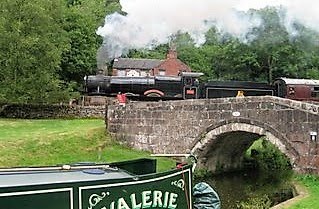
NB Valerie & Steam Train by Les Biggs

NB Valerie & Steam Train by Les Biggs