How to Leave a Comment on Our Blog

HOW TO LEAVE A COMMENT ON THIS BLOG
1. Scroll to the end of the post.
2. Click on the phrase "0 comments" or, if there are comments it will indicate how many, for example, "8 comments." Clicking on this will open the comment option for you.
3. Type in your note.
4. Choose your Profile. If you don't understand the choices under Profile then choose Anonymous but PLEASE type your name and location at the bottom of your comment so I know who you are!
Showing posts with label Wigram's turn. Show all posts

Monday, April 11, 2016

From Our Keyboard to Our Front Door

"I love ordering things online because when they arrive it's like a present to me, from me. " ~ Anon.

   As Les mentioned previously, the spot near Birdingbury Wharf and the Boat Inn pub on the North Grand Union Canal is a great place for having items delivered to a boat. It offers easy access from the road, a house address right across the lane from the canal, plenty of space for a delivery van to park, and a good gap in the hedge to bring things through to the boat. We had some crucial items that required an easy delivery location but we also needed to be in Braunston to take advantage of the Midland Chandler's Freaky Friday Sale offering 20% off everything in the store.
   It was decided that we would cruise up the three Calcutt locks onto the North Oxford Canal, stopping at Napton to spend two more nights visiting with our friends Andy and Tina, and then cruise into Braunston for the sale, after which we would come back to Wigram's Turn, down the Calcutt flight and moor up near the Boat Inn again for our deliveries, then turn around and go back up the flight, cruise back through Braunston, meet up with family and then cruise off North to Rugby and beyond. We thought we would escape the North Grand Union quickly after my knee healed but our old boat has other ideas. The batteries are knackered and need replacing, and we have to purchase the things we need for boat jobs when they are on sale. Such is life on a narrowboat.
Birdingbury Wharf is the good delivery place near the Boat Inn, on the Northern Grand Union Canal. The green line is our boat moored up. The Calcutt Lock flight takes you down toward Birdingbury Wharf and on into Warwick, or up towards Napton-on-the-Hill. The small red circle at the bottom is near Wigram's Turn where the Northern Grand Union and the North Oxford canal meet. It is also where Napton-on-the-Hill is located. The red circle on the upper right is in Braunston where Midland Chandlers is located. The double canal bridge arches are across from the Chandlers.
   We arrived in Braunston shortly after the chandlers opened at 8 a.m. and two refrigerators were already heading out the door on trolleys. Luckily since we arrived early we were able to moor up at the chandlery. We had a list of items, and were paid up and out the door fifteen minutes later, with Les hoiking a huge tin of bitumen on a trolley. We have blacking to do soon.
Freaky Friday Goods!
   We moved the boat ahead ten feet to the service point and dumped our rubbish, filled up with water and watched the new owners of author Terry and Monica Darlington's boat Phyllis May II cruise past. 
   As we were setting off, I spied NB Millie M. on the chandlery moorings. Maffi was in town so we breasted up next to his boat and had a quick natter as he came back from the sale with his goods in tow, then we headed off in different directions; and that is often how things happen on a narrowboat--time enough for a short chinwag and then everyone cruises off.
Saying goodbye! Maffi, dog Mollie, and his boat NB Millie M. He backed up stern first through the left arch in order to turn back towards Braunston Marina. We came through the right arch with our bow pointed back down toward Napton, Wigram's Turn and the junction with the Northern Grand Union and yes--once again the Calcutt locks. The roof of Midland Chandlers is poking up above the footbridge, their mooring empty now that we have all moved on. 
   We headed back down toward Napton and down the Calcutt locks to moor up near the Boat Inn in order to take delivery of a few things we needed: groceries from Tesco and four new batteries from Advanced Battery Supplies. Many thanks to our friend Robert Rogers for sharing this excellent web site. They offer reasonable prices and free next day delivery. Currently they have a special offer going for narrowboat batteries and the prices include VAT. 
   As it happened, just as we moored up our alternator crapped out on us! Good thing we were in the perfect location for River Canal Rescue (RCR) to pay us a call. An engineer removed the alternator and took it away for testing. It turned out to be knackered beyond repair and we ended up with a brand new alternator--not a refurbished unit. The alternator was covered under parts replacement by RCR and we were only liable for the £50 pound excess/co-pay.  
Tesco delivers to NB Valerie.
NB Valerie, new batteries, and the courier with his van. Easy-peasy!
Each battery weighs 25 Kilos/55 Lbs. each!

   After taking our Tesco groceries aboard, the four new batteries arrived soon after and the new alternator was fitted later the following morning. Sorted! 
   In the mean time, feeling like extras in a British re-make of the movie Ground Hog Day, we worked our way back up the Calcutt locks, and moored up in Braunston. A delightful day was spent in the company of our family who came up from Watford to visit over a lunch of fresh baked bread, homemade Tomato and Roasted Red Pepper Soup, and Brownies. Did we get pictures? Well of course not because we did our usual Les and Jaq thing: we had such a good time with our daughter in law, her mom, and our grandson, that we forgot to take pictures!!! 

Thursday, September 03, 2015

Napton-On-The-Hill: Windmills and Friends

"When the winds of change blow, some build walls, others build windmills." ~Chinese proverb

    This is a LONG post folks, but it is mostly pictures so if you are sitting inside a clammy boat in the rain, or trapped indoors by the unforgiving smoke from the raging PNW (Pacific Northwest of the U.S.) fires, perhaps you would like to refresh your soul with a cup of tea and walk through the English countryside to an ancient village church. Enjoy the sunshine on a drowsy afternoon in England and walk along with us. You might be surprise at what we find! We might even play some children's games--Okay you're it!!


We were were penned inside by three days of rain in which Les moaned like a child, "I am bored. I just want to be moving again." Me too mate!!
    We decided to leave our secluded country mooring on the stretch of the Oxford canal shared by the Grand Union, and cruise to Wigram's Turn. We went up to the top lock of the Calcutt flight and pulled in to fill up with water, then we winded the boat and cruised back to the junction, heading for Napton. Our dear friends Tina and Andy on live nearby and we always stop to visit while we are in the area. 
     Of course every inch of mooring space was rammed with boats. We cruised slowly through Tomlow Road bridge; I kept my eyes peeled for a space while Les kept his eyes on the canal ahead. As we slowly passed the first two boats a lovely red and blue boat with a familiar name appeared: Carrie Ann. As NBV crept by I said, "Les look it's Sue and Colin's boat--Carrie Ann!" Of course we were all excited now as the last time we had seen them was a sunny Sunday in August at Fenny Stratford when we were heading back to Cow Roast to settle in for Les' liver surgery a year ago. They don't blog and spend no time to speak of on-line so we had no idea they were nearby.
     I called out and up came Colin who welcomed us enthusiastically. We pulled over and breasted up next to their boat and out came the chairs. We sat on their cruiser stern in the afternoon sunshine drinking tea and catching up. I even had a pet of their lovely boat rabbit, Winston. While we sat talking, the boat behind them decided to leave and we pulled in to moor up in the space. Sorted!! If you see them cruising along please wave and say hello. Col and Sue are lovely folk and have taken to living aboard as continuous cruisers quite well.
Sue and Colin next to their boat Carrie-Ann. Winston the boat rabbit is inside looking for a nibble!
     The next day Les decided we had to walk up and see the windmill. For those who aren't familiar with this area, Napton-on-the-Hill is famous for the large dutch style windmill that caps its 500 foot high crown. While I was enthusiastic for a walk I am ever leery of Les' description of how long it will take, how easy or difficult it will be, and so on. He is notorious for telling folks a walk of thirty minutes only takes fifteen. What he told me was, "Okay Jaq, if we walk up to the Tomlow road bridge and up through the village it will be far harder. The path is quite a climb and I think it will be too steep for you, but if we walk along the towpath toward The Boat pub and cross the road to the farmer's field it is a longer but gentler climb to the top." Uh-huh...
      So off we went, favored with a beautiful summer day, a bonnet-blue sky and the luscious yellow sun tempered by a lovely breeze. 
A climb through nettles and blackberry brambles left my ankles red and raw...
...but it was worth it to see the field covered in rabbits. Dear Sir went ahead of me, closed the gate and insisted I pay his customary toll fee; a kiss, hence the reason why we call these "kissing gates!"
The ancient ridge and furrow field system can still be seem here. High ground like this was turned over to grazing sheep and has not been tilled since the 15th century.
      Ridge and furrow is the way farming was done in the Middle Ages. It actually dates from the immediate post-Roman period (499 ACE) to the mid-17th century in some places across Britain and Ireland. These distinctive fields came about from being ploughed with non-reversible, single sided ploughs each year. Each strip was held by one family with large open fields held as common space and shared amongst the villagers. this is where the term furlong came from as a strip was generally a furrow long--about 220 feet and from five to over twenty yards wide. According to Paula Levick in the Archeology of East Oxford, "There were practical advantages in creating ridges – they increase soil depth and add to the overall surface area of the field, and the furrows between assist in drainage." (Accessed on line on 07/19/15, https://www.archeox.net/fact-sheets/ridge-and-furrow) 
All righty then, to quote my Best Beloved, "It's a gentle climb..."although he neglected to say we would be wading through fresh and drying piles of cattle, sheep, goat, emu, and rabbit poop!
"Come on Jaq--the summit of the hill is just 500 feet ahead!
At the second gate to the next field, another toll must be paid. This walk is definitely improving! Looking back towards the bottom of the first field.

"Farmland: Please keep to the path and keep your dogs under control." 
A rabbit hole! The fields were full of them all near the edges and the top. Now where is my pocket watch...
A buzzard rides the thermals...
...while I stand in silent reverence, drinking in the view. The canal and our boat are down there somewhere...
...but it matters not where we are moored. I feel small and insignificant perched on the brow of this hill where it is said one can look out over seven counties!
Away to the left lies the city of Coventry.
      We walked up hill across two large fields. The lower section had penned animals, rabbit burrows, and lots of poo; the second field had one large rabbit hole and a brow of hill with breathtaking views West and North, and we still weren't done climbing! As I turned away from the buzzard in flight and the vista across the Oxford canal and beyond, I faced a short, wide field with sheep which had been sheared but their tails were left long and they seemed to be wearing pony tail holders or rubber bands every so often down the length of their tails to to keep the hair in place. These were the cleanest sheep I've ever seen!
The clean, long tailed sheep. I was beginning to wonder about the people farming this hillside. It all seems less than conventional to allow rabbits to burrow without closing up the holes, and sheep were allowed to keep their tails albeit under control.These animals were sleek and clean. Hmmm...what else will we find as we walk over the brow of this final bit of hillside?
One final reminder to dog owners!
     We came out of the final gate onto a dirt lane which cut across the very top of the hill. Across the lane was another large field which stretched away down the other side of the hill. In it we found some very interesting cattle!
These braw animals are Highland cattle...
...and the "coos" all have names!
Not your run-of-the-mill road sign!
     Well that clinched it for me. Obviously we are not dealing with your run-of-the-mill farmer. I was intrigued. From the names on the list it appeared they were all cows except Gorse, Bracken and Frosty--the three bulls. After admiring the fluffy cows we followed the lane a short way on and came to a penned triangular corner of field in which a picnic table, and separate bench and a memorial plaque were located in the shade of a tree. It says: 
     You are welcome to use the seat on this private property at your own risk. This seat and Rowan tree are on the site of the WWII Observer Post operated by the Royal Observer Corps. It was part of a network of observer towers built for the purpose of providing a system for detecting and tracking aircraft. the Blitz on Coventry (to the North of this spot) on November 1940 would have been observed from the tower. Villagers also witnessed the event from these fields. The tree was planted on the 50th anniversary.

     The Oxford canal is close by and also played a part in the defenses of the area in WWII. Following the fall of France in 1940 a German invasion was considered imminent and part of Britain's defense system was a network of infrared stop lines. The canal around Napton was part of the Western Command's Napton to Coventry stop line. Evidence of these defenses can still be found on the canal to the south of this spot. There are still Stent Pill Boxes and anti-tank blocks to the side of, and just off of the canal. 
     The support to this Country in its desperate hours by such people as the Observer Corps, the Home Guard, the Women's Land Army and the Agricultural and Horticultural workers who fed and protected the Nation is not always adequately remembered. So please take time to sit and reflect on the freedom we have today. 
The memorial plaque and the windmill.
     At the start of WWII Coventry was a town teeming with over 230,000 citizens. It was a hub of the metal industry in this country, manufacturing bicycles, automobiles, airplane engines and munitions, making the city fair game as a target during the war. In typical British fashion its factories sat cheek-by-jowl with its workers; homes, and shops such as bakeries, dry goods, greengrocers, butchers, and of course the church. 
     Between August and October 1940, the German Luftwaffe (air force) bombed Coventry eighteen times, dropping 198 tons of ordinance on Coventry killing nearly 200 people and injuring over 500. 
     On November 14, 1940 the Germans tried their best to bomb Coventry off the map. Five hundred and fifteen German bombers flew a mission code named Moonlight sonata, dropping 500 tons of high explosives, including 36,000 incendiary bombs. High explosive bombs and air mines coupled with incendiary devices turned the city into a firestorm. Coventry's defense consisted of twenty four 3.7 inch AA guns and twelve 40mm Bofors, which are large anti-aircraft guns on axles and wheels with long barrels. 
     The bombing commenced at 8 p.m. and lasted until the all clear was sounded at 6:15 am. While nearly a thousand people were killed or injured the casualties were not higher due to the air raid shelters which housed thousands upon thousands. Another thing that saved lives was the habit of Coventrians trekking out of town each night to kip in nearby towns and villages or in the fields to avoid bombing.
   The destruction of Coventry was so severe Josef Goebbels, the Minister of Propoganda for the Third Reich adopted the term "Coventriert" when discussing plans to undertake similar large bombing raids on other allied towns and cities. 
     The BOOM of anti-aircraft guns, the drone of German bombers flying overhead, the snap and crackle of bombs detonating as they hit their targets, all would have been heard by the villagers of Napton standing witness on the winter dark hill. Smoke from the firestorm would have blotted out the horizon in the distance, their cold breath coalescing in the frigid air to mingle with the distance smoke of thousands of bombs cracking Coventry to its core. The firestorm would have lit the night sky like the devil's own bonfire. It was a sobering thing to contemplate on a fine, bucolic summer day seventy five years later. 
As we sat on the picnic table at the memorial, our backs to Coventry, another lovely vista opened before us, this time spreading out toward Oxford.
Up the lane we walked toward the private home with the windmill...
...to find a public towpath veering off to the right, parallel to the hedge.
Following the public footpath a short way we discovered this breathtaking view looking south toward the city of Oxford.
Aha! These two are the farmers who run the clean, long tailed sheep and name their Highland cattle.
    As we walked back down the lane across the top of the hill, we met a Land rover coming out of a tree shaded drive. They rolled down their window and we commenced a twenty minute chat! These two lovely people have been married nearly fifty five years. they were both born in the village of Napton-on-the-Hill; schooled here and have farmed the land for nearly as long as they have been married. He was a medic and she a nurse. They retired early from the NHS and he undertook schooling as an herbalist! they use all natural treatments for their animals whenever possible as well as for themselves. They raise their stock organically and sell the meat locally. 
   We mentioned the WWII plaque and he told us it was their idea! They set the corner of land aside and built the memorial. She was eleven years old when Coventry was bombed. I asked if she remembered seeing it from the hill top. She soberly nodded her head. 
   "I remember the flash of light in the sky as each bomb found its target. We could hear the percussion as they struck and hear the booming of the British guns as they answered back. It was a hellish thing to see in the skies so close, knowing people were dying and there was nothing we could do." We parted eventually, thanking them for taking the time to talk with us.
    On our way again we followed the leaf sheltered track around and came to the 12th century village Church of St. Lawrence where American actor Ed Bishop is buried. He made his film debut as the cabbie in Kubrick's 1962 film Lolita. In 2001:A Space Odyssey Bishop played the captain of the Ares 1B Moon shuttle. I looked for his grave but didn't find it. 
Les takes a break from our stroll in the churchyard, as the bells toll, filling the sun drowsed air with notes.
Old moss covered stones lean as a bright bunch of Cosmos dance atop William Eadon's grave.
Old Celtic crosses stand side-by-side, sentinels of the churchyard.
Old crosses atop long forgotten graves lean toward one another as if to whisper, "Remember me?"
   We are impressed by the church yard of St. Lawrence, Napton-on-the-Hill. It is the best kept yard we've seen in all our travels. After a meander around, reading the gravestones, and short rest on the benches in late afternoon sunshine, we quickly tried the front doors but they were locked. We stopped to read the grafitti etched into the soft stone. Most of it was modern, but we found the date 1680 tucked into a lower corner!
  Turning around I was taken by the view of the alee of trees before me, leading out of the churchyard and down School Hill to the village. It took my breath away and brought thoughts of eternity. This is the only churchyard in which I have ever been on two continents, which actually made me contemplate the hereafter in any meaningful way. 
                  Isn't this an atmospheric view? It felt as if time has spun itself out and stopped--a forever moment that engendered thoughts of eternity of a grander scale.
The view back up to the church door, which would have, in some similar form, greeted worshipers throughout the centuries--from the 1100's to the present. Local lore says the church was supposed to be built at the bottom of the hill in the heart of the village. three times villagers started to build the church down below and all three times the stones moved themselves in the night to the top of the hill where the church sits today. 
Away we walk, down School Hill, as time reels itself into the present and begins ticking forward once again.

   As Les and I walked slowly down the steep hill to the village proper, small side gardens beckoned to us with their shady nooks and floral glories. Our thoughts turned to school children making their way down the hill to the school in howling winds and winter storms. Such events seemed impossible to hold onto on such a beautiful day.
  The view looking down on the village was striking. It seems as though it would be a child's paradise in which to wander, playing hide and seek in the labyrinth of hilly, shaded public foot paths, winding lanes and obvious places to step and catch one's breath and sip the view. Imagine reaching the War memorial as dusk falls and calling out, "safe!"


The old school is actually located behind me, across the street from this sign. Almost there!
My Best Beloved sits on the bench waiting for his wife who snaps 80 pictures on a two hour walk! The old School is out of site on the left. the War memorial is just in view, left with its brick back facing School Hill. The Old parsonage sits at right, remodeled for the 21st century.


   For those Americans who are not familiar with the impact of WWI on this country, the middle tablet bears the names of twenty nine men of this village who lost their lives in "The Great War." Two brothers, father and son, Two fathers and their sons...compared to the smaller loss in WWII of eight village men. This same sad epitaph repeats itself in every village and town across this country.
   As I stand reading the names I am struck with the deadly understanding of why this was known in Britain as The Lost Generation. So many men were killed, a glut of women were left alone at home to mourn their husbands, brothers, cousins, uncles, sweethearts; the women were left alone to pick up the pieces and try to build a happy life in spite of the  absence of their men; their grief spent itself in the Jazz era, as women let go of circumspection, lifted their hemlines, cut off their hair, took up smoking and drinking. After all, the war proved anyone--anyone at all--could die tomorrow. 
   If I had been raised in this village, I would have used the War Memorial as a "safety" in children's games because there is no doubt in my mind at all that every child in the village would recognize at least one person's name in the epitaph. What better place to reach and call "safe" than the monument which consecrates the sacrifice and loss of your older brother, your father, grandfather, great grandfather, great Uncle, second cousin...
This is the back of the Old School House--now private residences. The War Memorial and bench on which Les waited for me are just out of site on the left.
The view over the roofs of the village to the fields beyond from the War memorial and the back of the Old School House.
As we continue to walk down the lower hill into the heart of the old village, I spot a thatched roof peeking through an apple tree.
Now a private residence, this was once the village bakery. Napton was designated as Neptone in the Domesday Book of 1068. It is a corruption of cneap and tun meaning hilltop and settlement. The village was granted a royal charter for a market in 1400. At one time it was the largest settlement in Warwickshire. The market died out and today the population is about 1000--the same as in the Middle Ages.
Right next door to the old thatched bakery house is this now defunct village pub. From 1899 to 1973 a brickyard on the lower far side other side of the hill near the canal offered employment to the villagers--many of whom would have gathered here in the evening for a pint on the way home. Empty and sad looking, I cannot help but think, "If those walls could talk!"
The Old Granary left, has been restored with a modern addition on the right. It's now re-purposed as someone's home.
On the main road through the village now, we pass modern cottages like this one...
...and this whimsical bijou garden caught my eye.

Yet another public footpath disappears up the hill on the left . Don't you just love free range children?! Ollie, ollie oxen-free!
Yep--you read it right: Butt Hill! what the name actually refers to though are the archery fields or butts that once stood up hill closer to the church. In fact it seems the grooves carved in the soft rock of the church porch columns were made back in the 1500's by men sharpening their arrows before competition at the Parish Butts commenced.
The intersection leading to Napton Narrow boats to the top, to Southam at left, to Daventry right and behind me, back up into the village. Out of site on my left is the Kings Head Pub.
The Kings Head Pub is a five minute walk from the Oxford canal and it has superb food!! Those who know me, know that I am a very good cook. I don't eat out at pubs unless the food is at least as good as I can fix at home, and hopefully better. I had one of the finest meals I've eaten in this country or back in the States at this pub.  If you want to eat here be sure to call and book a table. They are always busy.
I've enjoyed several late night walks back to our boat with Les, Andy and Tina after a meal and drinks in the Kings Head. It looks much prettier in the daylight!
Les stops to look over the side of the Tomlow Road bridge...
...looking down on Napton Narrowboats hire fleet and Napton Marina. Wigram's Turn is back out of site beyond the trees.
This is the view looking down on the opposite side of the bridge. The canal travels down to the city of Oxford in this direction, eventually hooking up with the river Thames.

"I'm a little teapot..." not really! Les is waiting yet again for his wifey to quit taking pictures and catch up. Over the bridge, down through the gate to the towpath...
...and under the bridge.
Why is it the boat by the bridge nearest parking, or the service point for water, rubbish, etc. usually has a sign in the window indicating they are broken down? It makes such a great excuse to overstay doesn't it? We've been broken down three times in my four years aboard. RCR (River  Canal Rescue) had us up and running again in 24 hours at the longest.
Home again , home again jiggety jig! Les removes the lock on the back hatch and we collapse over a cup of herb tea.

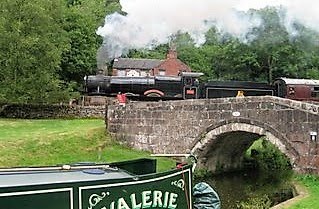
NB Valerie & Steam Train by Les Biggs

NB Valerie & Steam Train by Les Biggs