How to Leave a Comment on Our Blog

HOW TO LEAVE A COMMENT ON THIS BLOG
1. Scroll to the end of the post.
2. Click on the phrase "0 comments" or, if there are comments it will indicate how many, for example, "8 comments." Clicking on this will open the comment option for you.
3. Type in your note.
4. Choose your Profile. If you don't understand the choices under Profile then choose Anonymous but PLEASE type your name and location at the bottom of your comment so I know who you are!

Friday, March 04, 2016

A boat trip to the hospital.

In prison but we still get the choice of transport to Jaq`s physio classes. By boat beats the bus or car and we are always guaranteed a mooring space, no charge. At Warwick hospital a two hour car park charge is £3($4.50). In London at the Royal Free it`s double that. 

I guess we have two prisons here say Dartmoor and Brixton, U.S. readers that`s rural and urban. So our trip begins in rural Radford Semele and ends in urban Warwick with little snatches of rural along the way.

There is on this post a heck of a lot of pictures, think of the numbers 5 and 8, possibly multiplied, added,subtracted, showing our trip but i make no apologies as being stuck here in the five mile prison blogging subjects are few and far between and this one just escalated. Just to emphasise the prison aspect this is the same route we take to go shopping or to get water and diesel but if you pick a bright sunny day it can be a mini holiday from clink. Click here if you don`t understand the word clink.

 Leaving the fields in front of the church and Radford Hall we
 pass under the main Leamington to Southam road.


Through the bridge and immediately on the left is the site of the Radford Hall brewery that closed in the 1960`s.


I would prefer that the old brewery building was still there. The canal is to the right.
 
 Windows on Warwickshire


 Now we are passing through Sydenham Farm housing estate and the bridge ahead was the access to a wharf cottage on the left perhaps to serve the farm or nearby sewage beds, maybe both.


 The tickle family were farming here in the 1920`s and in 1954 purchased the farm for £12,000($18,000). Not sure of the size but today 2,000 homes, 3 schools, 2 pubs and some shops occupy the site. With the industrial area it must as far as i can measure total 80 acres or more.  I wonder what it all sold for in 1959.


 Moving on we are now entering the outskirts Leamington Spa and housing like these streets of terraced houses stand as if defeated of any further advancement by the canal.

 Then comes our first winding/turning hole. This was once an arm built in 1892 so that boats could tranship cargoes to the railway. It was about a 120yards long.
A 1934 view of the arm from the Britain from above site.

 Before we go any further let`s just take a look at this 1885 survey map with 1923 revisions of our journey so far.
A is the mooring at Radford Semele. Look to the right here and you can just make out a narrowing of the canal and a footpath. Earlier maps show a Drawbridge here and in the hedge along the towpath is what looks like the original stonework for it.
B is the 1st. bridge we came under with the site of the brewery on the left.
C is the access bridge to the wharf cottage.
D is the canal basin/arm.
Sydenham farm buildings are in the centre and you can see the size of the farm enclosed by the railway and canal.
Maps from national library of Scotland.

Housing now almost on the towpath facing the old arm entrance.

More terraced housing standing like soldiers waiting for orders


Gardens reaching down to the waters edge.

All that remains of the old L.N.W.R. Leamington to Rugby line that ran past the brewery and the Radford mooring crossing the canal again at Radford lock.


After crossing the canal the railway went through here.


Start of the Rangemaster factory
Now we are in Leamington and this was the location of Eagle Foundry built in 1833.
Flavel took over Eagle foundry in 1856 and one of it`s early products was the Flavel Kitchener.(left)  Flavel became Rangemaster/Aga who still manufacture here and on the right is pictured the one millionth stove to be produced about a year ago.


Eagle foundry from the canal about 1850.
Flavel factory 1937. Notice the footbridge over the canal still part of the present day scene.


Passing under bridge 40 that leads to the old high street area of Leamington and the main town centre. Could do with a lick of paint.

On the left after bridge 40 was the site of Leamington gasworks built 1819. Canal boats delivered coal and Thomas Clayton boats took coal tar away.
Same view showing the Gasworks about 1930. The gas holders can just be seen behind the White building but were dismantled in 1982

Now starting to move away from Leamington

Even a place like Royal Leamington Spa has it`s share of litter louts.


The last of perhaps what might be rentals, identical chairs on each balcony, before the canal takes on
 

a rural feel in this cutting.

One of three canal side pubs within the prison limits.


Plenty of housing along here but looking at old maps reveals just fields.


An aqueduct takes the canal over the London-Birmingham tracks.

Now we have snatches of open fields although distant housing can be seen. At times we have seen sheep grazing here.
Across the canal again a hint of openness. A 100+ years ago just Jephson`s farm is marked here amongst fields. 

Next the canal crosses the River Avon on yet another aqueduct. This is where some modern day canal builders want to have locks down to the Avon to make another route to Stratford on Avon and onto the River Severn at Tewkesbury. I did read the idea of using the R. Leam and joining the canal at Radford. Not in my lifetime but who knows what the future might bring.
Aqueduct over the River Avon.

A now and then shot of the canal at Emscote road bridge 46. Tesco is to the right if that helps those having boated this way. The working pair are just about to go under the bridge. Picture dated pre 1960.
In 1805 Emscote corn mill was established here with the grinding wheels powered by canal water. It was altered in 1885 and 1905 and ended life as the Fleur de Lys pie factory that the flats are named after.
Late 1880`s maps show a boat building yard and slipway next to the bridge. Also at this time a tramway is shown crossing the bridge. This turned out to be not something to do with the canal but horse buses.
The horse buses were replaced by electric trams in 1905 when the Tesco site became a power station and a Tram depot.
The 3 mile route between near Leamington and Warwick ended in 1930. Boating would have been much more fun to see these going over the bridge.
 Electric Tram in the depot on the Tesco site. The power station was fed by coal delivered by canal and used water from the  River Avon.

This is the site of Emscote Mills where the Nelson family made Gelatin from hides, calves hooves and animal tissue all of which came by canal boat. This is the same Nelson family that had quarries and lime kilns at Nelson Wharf that I blogged about here. Lime came from Stockton to Emscote to be used in the gelatin production. As at Stockton the Nelson family built housing here and a social club(right) for it`s workers and it`s all still there today.
 Emscote mills in 1900. A good place to start if you are like me a history buff is HERE. The first picture you will see is an aeriel view of the works. The canal bridge to the right in the aeriel view is 48. The works stretched almost up to the present base of Kate Boats. At bottom of page there are a large number of links with some interesting reading.

 To the bottom right the canal crosses the two aqueducts then passes the corn mill and tramway depot. Under Emscote road bridge and a very short distance brings us to the Emscote mills gelatin works. Mills with similar names, the other mill was originally called Emscote corn mill and went on to be called Navigation mill.


OK so by now you might be tired of this epic blog but I can only apologise but I got carried away as i kept finding out bits and pieces of the route to the hospital. Just about there now so we can just cruise past what was mostly the gelatin works


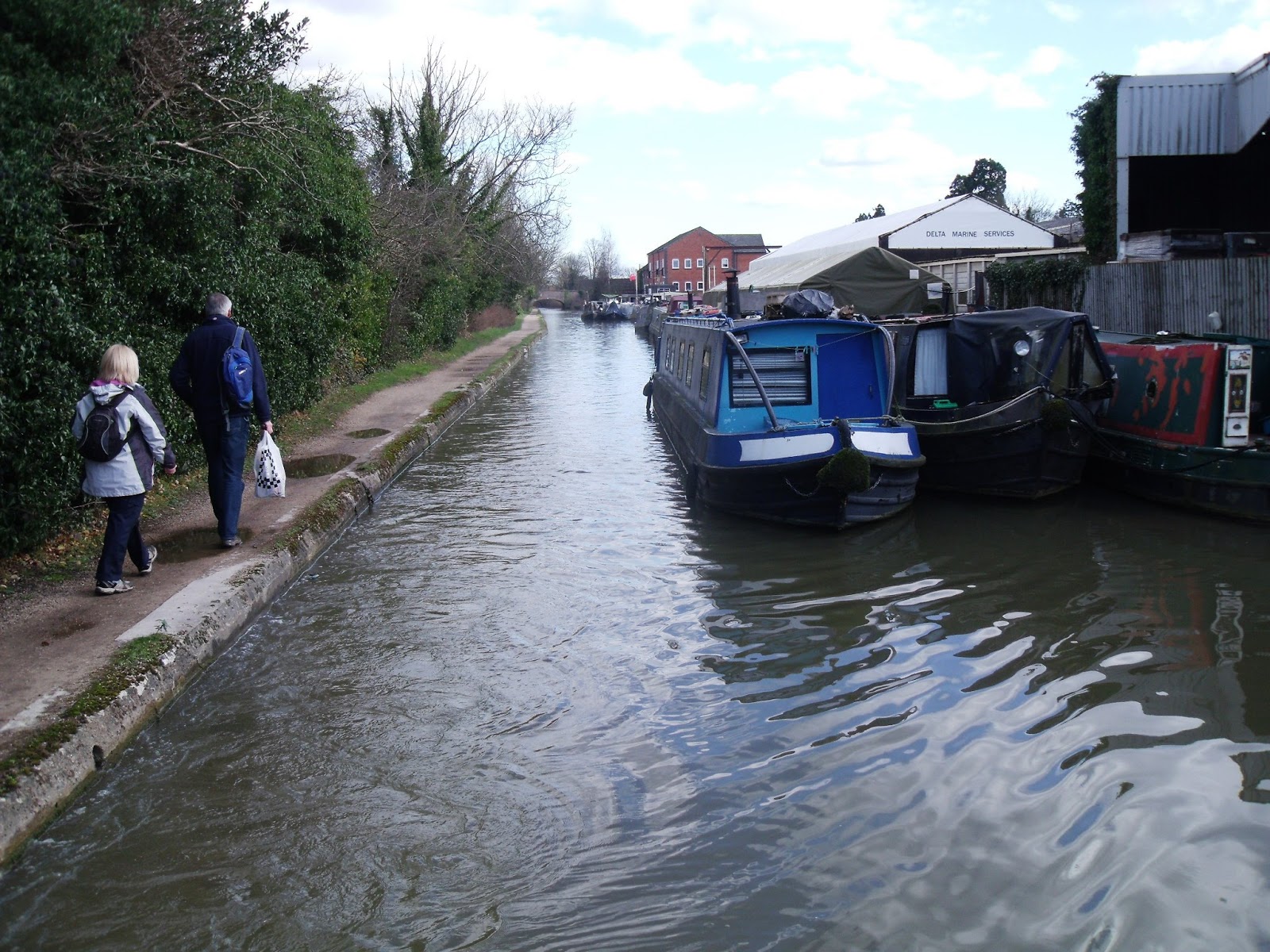


A bit tight, about 8 feet.

Kate Boats hire base.


Good sign, summers on it`s way.
Here we are this is our mooring opposite the hospital, the footbridge is just ahead. Unlike Radford we are near to housing but that is a small price to pay for the convenience. We have to come this far for water, about quarter mile further on. Every opportunity we always return to Radford which has become our country estate.

All that remains is to make sure our cell door is firmly shut before we settle down.
All finished, all readers having kept going to to this point deserve a medal, well done. That number of pictures I mentioned at the beginning was correct...58.
I am now going to lie down....for a year.


Tuesday, March 01, 2016

Almost Like Importing Coals to Newcastle???

Image result for iditarod quotes
  As we tarry awhile here in Warwick while I continue to heal, a dear friend in Burlington, Ontario sent me a link to a news clipping titled "Fairbanks to the Rescue: Railroad to Haul Snow to Barren Anchorage for Iditarod"  about Alaska--or to be specific--about the total lack of snow in south central Alaska where Anchorage lies. There is so little snow that it is being hauled down from Fairbanks, up in the interior as the region is known, by train cars and loaded into dump trucks to fill Anchorage city streets with enough snow to facilitate the start of "the last great race," as the Iditarod sled dog race is known and which begins March 5th. The ceremonial race start is in downtown Anchorage on 4th Avenue and is the only part of the race other than the finish line 1049 miles farther north, where there are throngs of spectators watching and cheering. Of course I knew about the dearth of snow from my sister Susan who lives in Anchorage. She shockingly confided to me last month that her neighbor was out mowing his lawn!!! But of course, there is no such thing as global warming...
     Anyway, if you love dogs, if you have great respect for working dogs, and you find challenges against the forces of nature too fascinating to pass up, then please do familiarize yourself with this race. The Iditarod Race commemorates The most famous event in the history of Alaskan mushing: the 1925 Nome Serum run. A diphtheria epidemic threatened the Native village of Nome, above the Arctic circle; especially the Alaska Native children who had no immunity to the "white man's disease". The nearest quantity of antitoxin was found to be in Anchorage--537 miles south as the crow flies. Although there were planes available at the time, both were out of commission with mechanical issues.
   With the Governor's approval an alternative delivery was planned. A 20-pound (9.1 kg) cylinder of serum was sent by train 298 miles (480 km) from the southern port of Seward to Nenana, where it was passed just before midnight on January 27 to the first of twenty mushers and more than 100 dogs who relayed the package 674 miles (1,085 km) from Nenana to Nome. The dogs ran in relays, with no dog running over 100 miles (160 km). If the serum had been transported by sleds all the way from Seward, it would have been a journey of just over 938 miles.
     The first commemorative race was held in 1967 and offered a purse of $25,000.00. In recent past years the purse was $600,000.00 with $50,000.00 awarded to first place and the remainder divided between the top 30 finishers, with every musher finishing below 30th place receiving £1049.00. This has changed in 2016 with the first place purse is $70,000.00, with an equal amount doled out to the first five through the finish line in Nome. The first prize winner also receives a new Dodge Pickup truck.
     Other prizes are given out along the way: a Rookie of the Year award is given to the musher who places best amongst those for whom it is their first time ever racing in the event. The Red Lantern award signifying perseverance is given to the last musher across the finish line; $3000.00 in gold nuggets is awarded to the first musher to reach the half way point of the race, along with a gourmet seven course meal. The nuggets are awarded back in Anchorage at the race awards banquet but the seven course gourmet meal is provided by a chef flown into the village of Cripple on the Southern Rout or Iditarod on the Northern route depending on which route is being run.  After days of eating energy bars and trail grub I imagine it tastes divine!
    There are two routes mapped out for this race and they are alternated with the the northern route run on even numbered years and the southern route on odd numbered years.
     The Iditarod also has an educational component: Teacher on the Trail. Every year applicants are sorted through and winnowed down until one individual is selected to be the Iditarod Teacher on the Trail. This year it is Lauren Wright form Austin, Texas who will be flown from checkpoint to checkpoint to report on the race for teachers and classrooms of school children all over the planet who will follow the race. Lauren will also provide lessons for classroom use. Teachers can send in an application to the Iditarod Education Department. From those applications, three teachers are selected as finalists. The finalists fly to Alaska, participate in the teacher workshop, have an interview, write lesson plans, and attend the banquet, the start and the restart. After the race is over, one of these teachers is selected to be the next years Teacher on the Trail™.
Post Script:

For our American friends and family: 
According to Wikipedia, the phrase in my post title, Carrying coals to Newcastle refers to the fact that historically, the economy of Newcastle upon Tyne in north-eastern England was heavily dependent on the distribution and sale of coal—by the time of the first known recording of the phrase in 1538, 15,000 tons of coal were being exported annually from the area—and therefore any attempt to sell coal to Newcastle would be doomed to failure because of the economic principle of supply and demand.

For our British friends and family:
When communicating with sled dogs the word "mush" does not mean run--it means chow time! Here is the brief lexicon of mushing and what each means:
Hike: get moving
Gee (hard G): turn right
Haw: turn left
Easy: slow down
Whoa: stop
On by: pass a team coming in the other direction


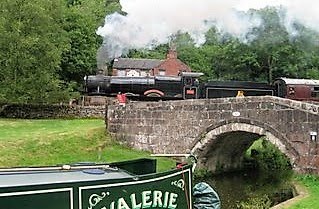
NB Valerie & Steam Train by Les Biggs

NB Valerie & Steam Train by Les Biggs