How to Leave a Comment on Our Blog

HOW TO LEAVE A COMMENT ON THIS BLOG
1. Scroll to the end of the post.
2. Click on the phrase "0 comments" or, if there are comments it will indicate how many, for example, "8 comments." Clicking on this will open the comment option for you.
3. Type in your note.
4. Choose your Profile. If you don't understand the choices under Profile then choose Anonymous but PLEASE type your name and location at the bottom of your comment so I know who you are!

Friday, May 04, 2012

Marbury: Medicine for Body & Soul

"And did those feet in ancient time, Walk upon England’s mountains green?
And
was the holy Lamb of God on England’s pleasant pastures seen...in England's green and pleasant land." ~William Blake


On our way up to Llangollen we stopped for the day just past Marbury lock. It was pouring rain. We brought a load of wood and coal inside, made some tea, and settled down to wait it out.

We didn’t wait long, and after the lull of the fire it was refreshing to walk, hand in hand through the misty spring time weather along small country lanes. I was excited because nature was just unfurling its green spring banner and as a medicinal herbalist I stop every few feet to examine local plant life as we walk along. Dear Sir has taken this excursion previously and he knows the beauty that awaits me…
NB Valerie on Llangollen near Marbury
As we walked down the lane towards Marbury village I looked back to see this view of NB Valerie. It looks like a fey landscape with lace trees! This photo hasn't been changed--this is exactly as I took the picture.


Tall hedges and narrow lanes-Marbury
This is a typical British village lane: narrow and winding, with tall hedges on either side. The air was crisp and clean; soft, clean, rain, fresh grass, and that elusive bright green, slightly sweet, liquorice scent filled my nose and made me feel thrilled to be alive for another spring. White Thorn or Sloe is flowering throughout the hedges, and puddles call to the child in me for a splash or two.


teh one lane road to Marbury with a passing place to the right and Les
Les serves as a visual measurement for the width of this lane. To the right is a passing place! What un-nerves me is how the locals tear down these narrow streets at break neck speed.


Dock leaves
Dock has a beneficial effect on bile production and is known as a valuable remedy in treating skin eruptions. Its high iron content makes it a good remedy for anemia.

Dock is a medicinal plant known in antiquity for its laxative effect. Centuries later in Anglo-Saxon England physicians used a mixture of Dock leaves, other herbs, ale, and holy water to cure people believed to have been struck by witchcraft with “elf sickness.” Common folklore holds that dock leaves will alleviate the sting of nettles. One often sees them growing side-by-side in fields. The root yields a yellow dye.


looking down the lane in marbury passed the old factory to teh lake
The village lane curves ‘round and downward to a small lake framed by on old oak. Marbury has been settled since at least 1200 BCE. It was mentioned in the Domesday Book of 1066 as having seven inhabitants. In 1551 sixteen villagers died of “sweating sickness”—most likely Influenza. Today the number of folks living in Marbury has grown to two hundred.


018
17th century two story outhouses on the left. These were not toilets—they were farm buildings. Marbury is dairy country. Cheese making was an important source of income in here beginning in the 19th century hence the thick clusters of cleavers fringing the lanes; by 1951 this artisanal craft died out.

Local history records that by 1850, nearly all local tradespeople were involved with agriculture, whether directly or indirectly. At that date, Marbury had two blacksmiths, butchers and shoemakers, and a wheelwright; later there was also a smithy, coal merchant, tailor, bake house and one or more grocer's shops. Today these thriving business are in the past. The center of this village is a natural conservation area.

Follow the lane around to the Swan pub, below, which has been integral to village life since the 1765.
swann inn 2
Directly across the lane from The Swan is a park with a fine view of the small mere (Welsh for lake)…


The mere across form teh swann Inn
…and the perfect seat under an old, gnarled oak planted in 1814, on which to sit and watch for birds on the water, or maybe doze in the afternoon sun while keeping one eye open for the locals coming and going from the pub!


old factory now flats marbury
Turn back up the lane the way we came and directly across the street from the old outhouses are beautifully restored buildings from the 1600’s--still lived in. The original inhabitants would have been eye witnesses to the English Civil War in 1642.


Cottage with heart on door
This cottage wears its heart on the door…


019
while this one makes a bold statement with a red entry!


periwinkle
Periwinkle is used in these postage stamp gardens as a ground cover. Vinca Minor is a hybrid of a Madagascan flower, Vinca Rosacea. It is poisonous and today it is used medicinally to manufacture Vincristine—a cancer chemotherapy drug.


Oregon Grape close up
Another popular plant in Marbury’s bijou plots is Oregon Grape Root (Mahonia Aquafolium)! I am astonished to find it so far from its natural home—Eastern Washington and Oregon. It is typically used as a hedging plant, growing to six feet tall over a period of years. It has sharp, pointed, leathery green leaves similar to Holly.

In spring it forms clusters of bright yellow flowers beloved by bees, followed by dark blue berries. Most folks have no idea that this is a very potent and vitally important medicinal plant. It is the three year old roots that are used to make a decoction which will kill viral illnesses like Influenza. Oregon Grape contains immune boosting, infection fighting Berberine. The whole root contains tannins that ease inflammation, irritation, and itching of the skin.

It has a considerable reputation as a blood purifier, cleansing the tissues and blood of toxins and waste products. Its bitter components stimulate the liver and gall bladder, and are tonic to the digestion with a mild laxative effect. (Caution: this plant should never be used during pregnancy.)

To make a decoction, dig the root up and divide it in year three. Take a healthy bit of teh root and wash it thoroughly. Towel dry and chop it into pea sized pieces with a very sharp knife. Add one ounce of Oregon Grape root to 4 cups of clean, cold water in a non-metal pan with a lid. Bring quickly to a boil.

Once the water is boiling, set the pan on another burner turned as low as it can go. Simmer very gently for 60 minutes. Don’t open the lid or you will lose beneficial alkaloids in the steam.

Remove from all heat and allow to cool for two hours. Pour all ingredients into a clean quart jar and cap it off. allow it to sit for 12 hours. Strain the plant material out and keep the liquid.  This will only keep for about two days refrigerated. You can add one fourth cup of brandy to it to help it last longer. Drink a quarter cup two times a day until the decoction is gone.


The church tower Marbury
Les pointed out the tower of St. Michael and all Saints Anglican church as we walked along…


Walkingup the lane to Marbury church
Dear Sir walked ahead of me while I stood, enthralled by the beauty of the mist clouded view. The only sound was that of a light wind ruffling the grass and bushes with a birdsong chorus accompaniment. There were no other people, no cars, engines, planes, or anything to indicate we were in the 21st century. I could just as easily have been standing in the 14th century!

Marbury church form teh road
The entrance to the churchyard is through a lych gate. The word lych comes from the old Saxon word meaning corpse. In the Middle Ages bodies were buried in shrouds not coffins. The shroud-covered body was carried into the lych gate and laid on a bier where the priest said the first part of the mass for the dead under the roofed gate.

The lychgate of Saint Michael’s was built in 1919 and is dedicated to those who served and died in World War I. It is inscribed, “Ye who live on mid English pastures green, remember us, and think what might have been.”


Marbury church with tombstones
Inside the cemetery facing the front of this Sandstone edifice built in the 1400’s.


faces in stone and churchyard niches
Dear Sir led me around the side of the church to the back, a smile of anticipation on his face…


a peacefulcorner of the churchyards
…as I looked upon a vista of green fields enclosed by low rock walls…


stone wall encloses sheep in hte field
…and the village lane winding off into the distance.


the mere in teh back of the church
I gasped in amazement as another mere appeared behind the church…


The mere by the church 1
….beyond the low rock wall and the gravestones.


the  back of Marbury church
Les checked out the gargoyle faces carved from Sandstone as we stepped inside the church doors.


looking thorugh the church door
The wonder and simple majesty of hand carved stone and wood took my breath away.


Looking toward the stained glass windows
I was quitely speechless with marvel at the history of centuries in which humans have walked, knelt, prayed, rejoiced, and suffered within these walls.


here lie the reaminsof Deborah wife os Samuel  1780
In the floor, a tombstone worn smooth in places by the footseps of two huundred years says, “Here lies Deborah, the wife of Samuel…who departed this life June 27th 1780, aged 40 years.


047
Nothing prepares one for eternity like the interior of a 14th century church built by the un-named craftsmen without the use of modern tools, still standing and still used for worship, weddings, christenings and funerals.


organ pipes
This splendid organ takes pride of place up behind the pulpit, adjacent to the choir stalls.


050
This dark and mysterious cove in the belfry holds the cords for the church bells! One seldom gets to see this part of an old church. On the walls all around are plaques dedicated to those who still support their parish and its people many hundreds of years after they were laid to rest:


mary EAton plaque 1731
The above dated alms for the poor are from 1731; the plaque below…


charity for the elderly of hte parish 1839
…honors Mrs. Elizabeth Wright who gave in trust £100 in 1839, the interest of which is given yearly to all parishioners of Saint Michael’s who reach the age of seventy years, in equal shares.


beautiful wood pulpit
This beautifully hand carved pulpit dates to 1456.


1530 vicker Henry Dickonson
The list of Vicars begins in 1530 with Henry Dickonson and lists 43 names up to the present day. Parish records indicate John Talbot, Rector of Saint Michael's beginning in 1564, was paid a stipend of forty pounds, six shillings and eight pence a year. (I’m not quite sure what the difference is between a Rector and a Vicar. Both serve the Anglican church as priests and have paid positions as clergy.)


A window in memorium
This beautiful window was given in memoriam to the church in 1837.

Tithes of the parish in 1839- each dweller in the parish was assessed and paid tax to the vicar as follows: for owning 1 cow and calf-1 and half pence; 1 barren cow,one pence and one shilling; beehives-one shilling and one pence; 1 cockerel-2 eggs; 1 hen-1 egg; every master, mistress, child or servant over the age of 16 years-2 pence each; under 16 but over the age of 7- 1/2 pence each.


Teh interior church door
Pensively I reached the solid wooden church door, and stepped back outside into the 21st century. How many souls have stepped through this doorway before me?


close up of teh back of the church and the doorway
Outside I considered the eternal view of those who are buried here in the churchyard overlooking the mere…


graves overlooking the mere
…it brings to mind the words “How lovely is thy dwelling place,” of Brahms requiem from Psalm 84.


misty hills and gracestones
The clouds and mist over the mere frame the stunning view rather than detract from the visit. The rain has come and gone leaving the world quiet and clean…


someone's stone book is being returned to dust
…while nature reclaims someone’s book of life.


The crooked church tower
The bell tower of Saint Michael’s is 63 feet tall and leans 25 inches from vertical. It contains a peal of 6 bells which were given to the parish in 1719. “These bells have rung out their message of joy and sorrow, war and peace for over 200 years and still ring.”


stone cutters marks 1
These are the marks of the original stone cutters, made by human hands…


modern stone cut by machine
….and this is an example of machine cut stone where the front wall has been repaired. It does the job but lacks the mark of humanity that makes this old church so touching….


Marbury church with tombstones
…and timeless.


graves overlooking the mere
The front walk through the graveyard, with the mere beyond…


across the front graveyard to teh churchtower
…and looking back at the church. I was stunned by the atmosphere created by the weather. It could easily have been 1535…


The church tower
As we walked away I was filled with peace, and the pleasure of Les sharing the beauty of the the mere of Saint Michael’s with me.


rainwashed lane back to the boat Marbury
On the road back home to the boat I was reminded of Local author Beatrice Tunstall who described the village in 1948 as "far from the madding crowd", and praised the "ancient lanes, deep trodden by the feet of endless generation, flower fringed amid the woodlands, with great hedges where honeysuckle and wild roses riot." (Local History Group & Latham, p. 10)


1 canal, goose and hedgerow
Back on board NB Valerie, our view out the dinette window: a lone white goose patrolling in a green field, bordered in the distance by the hedgerow blooming with white thorn, along the lane we walked to Marbury and back.

Thursday, May 03, 2012

Bettisfield and the American connection

I apologise for another railway blog but I do like steam trains and all that is connected to them.


I came across the old Bettisfield Station while out walking from our mooring by bridge 47. It is on a branch line from Whitchurch and it went to Oswestry and beyond. it opened in 1863 and the picture on the left shows the station in the early 1960`s just a few years before Mr. Beeching`s axe came down and closed the line.
  This station and track were just a small part of massacre of Britain's railways in the mid 1960`s when 2,000+ stations and 5000 miles of track were removed. Luckily a lot of the stations like here at Bettisfield survived and become homes.

You can see the main building is there with an added extension in place of the brick flat roofed building on the right.
 Also the platform not clear in the lower picture is still there. New windows in the main building and a conservatory make it a lovely place to live.
 What I found when googling the station made me decide from a list of possibles to blog Bettisfield station.


Bettisfield station sits just inside the Welsh border and back in WWII was a link to military depots in Ellesmere and Oswstry. Bettisfield Park close to the station was in fact one such depot occupied by American forces. Troops arrived here by train from sea ports and stayed long enough to be trained for the second front in Europe.In 1944 allied forces landed in Europe and within days badly wounded American troops arrived back at Bettisfield on ambulance trains.
I would imagine a lot of other lines now defunct could tell a similar story. Born in 1948 WWII was to much part of my life. Dad was in the Royal Navy but would never talk about the war to me and he lived to 1998. Mum said he fought the Japanese but said very little to her other than his belief that if the Yanks hadn`t joined us things might have been a lot different.  Well dad if you can read this blog from wherever you are, I am doing my bit to keep the U.S./UK  partnership in tact.
The 2 views on the right show the old goods shed to the left now converted to flats(apartments) and apart from the house in the distance pretty much as it was all those years ago. I took the present day picture and just leaned on the bridge wall looking down imagining the trains stopping and perhaps a wagon or two shunted into the goods shed before the train moved on.
A Scammell Scareb articulated(semi) in use by British Railways
during the 1950`s and into the 1960`s 
I have always said I would have liked to have been an adult around the late 1950`s and lived a slower pace of life. No Mobiles(cellphone), your parcel would arrive by train and be delivered by an old truck as and when the stationmaster organised it. No courier next day by 9am, noon etc. UPS/Fedex were not heard of in the UK the good old Royal Mail delivered everything. Now, and I can still feel the stress of it typing this, courier company's rush around as does the rest of humanity chasing it seems each other in never ending circles. Just look at that old picture and imagine a steam engine chugging into the station not a Eurostar or an Intercity 125mph train or the new crazy HS2 that will plough through our countryside demolishing homes to save a few minutes between London and the Midlands.
Anyway my feelings about the slow life in the 1950`s is probably why I love the canal life. We have been moored here for a few days and have no pressure to be anywhere at any time. Bliss.......


Tuesday, May 01, 2012

Grindley Brook


"Book love... is your pass to the greatest, the purest, and the most perfect pleasure that God has prepared for His creatures." ~Anthony Trollope

At Grindley Brook, just before railway bridge 27 the canal curves as it travels through the bridge, making it difficult to see what is around the bend. What I know is out of sight just beyond are six locks--three individual locks, which open out to a short pound and three staircase locks--which will be my first. (Staircase locks for our American readers,are locks which open directly onto one another without a pound of water in between--so the gates are shared between the previous lock and the next one instead of each lock having 2 sets of gates all its own.)
Due to the sharp bend under the bridge and the first lock just after, this is a bottle neck, and traffic can get crazy, as boats pile up in a line, waiting to go up the locks. As we sit and eat lunch hire boats careen through the bridge without blowing a warning on their horn and slowing to listen for someone else coming the other way out of the lock. Some call this entertainment--I call it chaos. We've been told by other boaters that the Shell garage just up on the road past railroad bridge 27 has really cheap diesel, so we decide to put our steel Jerry cans on the trolley and wheel them up for a fill.
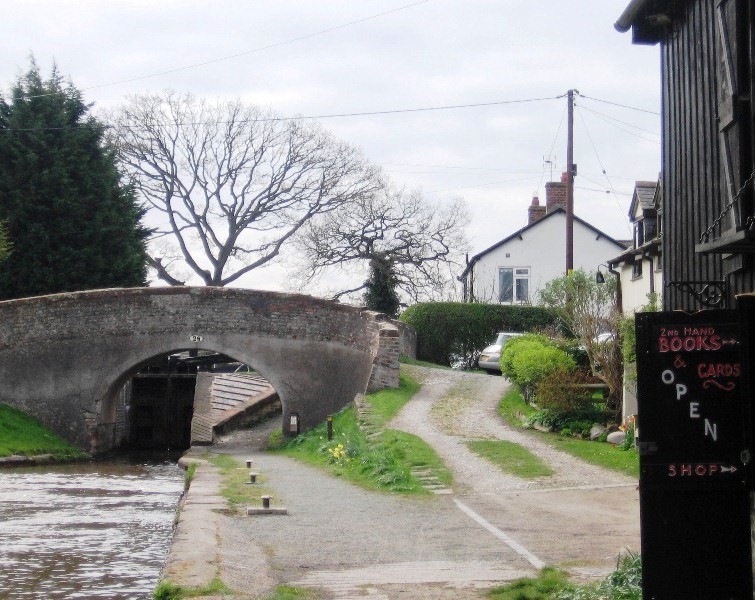
As we walk under the bridge a lovely surprise awaits! Lane Croft Wharf with its old canal side cottages immediately enchants me. Can you imagine sitting here beneath the bower of vines, perhaps with a book from the little shop nearby, pausing as a boat comes through the lock?
The old wharf building is re-purposed as a loft home with a jewel sized bookstore underneath. On the way back from getting petrol I stop and pick up five good books, sliding pound coins into the honesty box. I've never seen anything like it in the States. I find amongst its shelves a vintage hard backed edition of Anthony Trollope's autobiography. A bargain purchased as a gift for a loved one Stateside.
As we move off our mooring there is a queue of two boats ahead of us just past the bridge. The owners are in a heated argument about who is first in line.
The second boat moored up actually is first in line to go up; but he being a New Boater and inexperienced to boot, came through the bridge, saw no one moored up for the locks and took his half out of the middle of the bollards, leaving no room for a boat to moor behind him.
The next boat through the bridge had no choice but to go 'round and moor in front. That lovely old gent was an experienced live aboard single-handing it for the weekend. He simply needed to moor up where he could. Since New Boater assumed he would have all the bollards to himself and the middle was best for his shiny new boat, the single handed gent took what was left in front. He was not attempting to jump the Queue, but New Boater was not listening and stalked off to do the lock in a right lather.
By the time we came up to moor they had straightened out the misunderstanding and were helping each other with the first three locks.
Grindley Locks: A Pictorial Visit
Looking back at NB Valerie moored up before railway bridge 27 on the Llangollen canal.

Under bridge 27 looking toward the locks.
Looking through railway bridge 27. Bridge 28 and the first lock immediately after are just out of site on the left. The lane on the right curves toward the main road.
Now you can see bridge 28. To the right is Lane Croft Wharf and the gravel lane leading past several cottages and the bridge, heading right toward the main road.
Bridge 28 is in front with the lock gate visible just past it. This is where the two boaters got into an argument about the queue. The towpath connects with a gravel lane which turns right...

...onto a lane to the main road and the Shell station. Les with our Jerry cans and trolley.
The shell station on the road at Grindley Brook.
Les filling our emergency supply cans with red diesel.
145.9 per liter for petrol; five liters in a gallon. Add 50 cents to each pound to get the U.S. $ equivalent. Do the math Americans, and perhaps you will be humbled and quit complaining about about U.S. gasoline prices. I have yet to recover from the shock.
Jerry cans full of diesel costing us 81.5 pence a liter, we head back down the lane. Les goes back to the boat and I stand on bridge 28 to take in the lovely view...
...to my left looking down a hidden lane past a small cottage directly across the canal from the gravel lane, the towpath, and Lane Croft Wharf.
Here is a better view of the cottage from bridge 28. The rush of the water bypassing the lock creates a fresh, clean smell and the sound of rushing water.
The cottage garden is lovely; arbors flung with spring flowering vines, and seats tucked in out of the way places to watch the passing boats and listen to the water sing...
and back to my right is the gravel lane along the canal...
the lane, the towpath, and the old re-purposed Lane Croft Wharf building. The canal bends back towards bridge 27.
Take a seat on this bench; listen to the rushing water and the songbirds in the garden. Watch folks hiking along the towpath, and narrow boats mooring up in a queue to enter the first of Grindley's six locks. Close your eyes, wish real hard, and maybe...
you can make a little magic as everything around you blossoms! I love the robin's egg blue cottages. Their color makes my heart sing.


Look! There's a sign on the door of the old wharf building. It says "Book shop!"

I love book shops. How convenient to find one just here.
What's your pleasure? Books, art cards, book marks...hand made jams and old maps!

A view inside the pocket sized shop...
Don't forget to pay for your treasures. I picked up five good books to keep me company, and a special hard cover edition for someone I love. :)

Meat Pies

   Meat pies fascinate me! We have nothing in the States which come close. Only Swanson's or Maria Callendar frozen "pot" pies which are a short crust pastry filled with smallish chunks of gristly beef, dark meat chicken or turkey, with slivers of potatoes, carrots and peas in an insipid gravy. They may be found in the frozen food section. They are cheap but there is nothing cheerful about eating one.
Meat pies from Burland, Llangollen canal

   British pies on the the other hand are thick, crispy shells of short crust pastry browned to perfection and filled with a choice of Steak and Ale--large, tender chunks of delicious English beef and a rich brown gravy flavored with Ale; chicken and mushroom--again large, tender chunks of chicken, and a white, creamy gravy flavored with the merest hint of nutmeg, perhaps a bit of tarragon, and plump, juicy mushroom pieces.
   There are other flavors--Steak and Kidney, minced beef and onion for example. Mmmm! Also available are cold pork pies to eat with a cold salad. I found those too lardy tasting for my appetite.

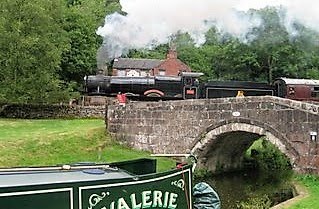
NB Valerie & Steam Train by Les Biggs

NB Valerie & Steam Train by Les Biggs