How to Leave a Comment on Our Blog

HOW TO LEAVE A COMMENT ON THIS BLOG
1. Scroll to the end of the post.
2. Click on the phrase "0 comments" or, if there are comments it will indicate how many, for example, "8 comments." Clicking on this will open the comment option for you.
3. Type in your note.
4. Choose your Profile. If you don't understand the choices under Profile then choose Anonymous but PLEASE type your name and location at the bottom of your comment so I know who you are!

Sunday, March 10, 2013

Part 2

Going to try and include more pictures of the canal for folk back in the U.S. so they can get more of an insight into the life of Jaq nowadays.

The decision to move away from the reservoirs was made after 8 days. Family had come back and forth and now we were to go into Luton on the bus to have dinner with family without transport at the moment. In the past - this might be useful to other boaters - the 61 bus ran past the White Lion and the Bluebell tearooms and provided a link to Luton, Aylesbury and Tring hourly. Now the 61 has been routed via Bulbourne and the 164 runs through Marsworth 2+ hours between buses. So being near the Bulbourne end makes it easier especially returning after dark.
As it happened son Kev gave us a lift back when he finished work, thanks son.
The cottage part way up the lock flight was recently sold and now has an extension on the back. In case anyone is interested this is where you can spot at least 3 old working boats taken out on the Wendover arm and slid down the incline to rest just past the cottage. Just walk past the cottage and look through the trees. Better in winter before the trees hide them away.


A recently fitted new set of lock gates but still slightly leaking. The gates weigh about 3.5 tons each and are made of British Oak. Canal River Trust have about 1600 locks to maintain and this year 173 gates will be replaced across the system. A lock gate has a life of 20/25 years.
This is the top lock 45 on the map (see last post) just near to point C. I am taking the picture from the bridge over the Wendover arm Junction ( see 2nd picture below).

Just a half mile on from the lock we filled with water and turned the boat . We are moored 3rd boat on the left. The bus we need runs just behind from where I have taken this photo.

So after a couple of nights we make the short journey back to the junction by the top lock. This area was the location for part of the 1964 film `The Bargee`. The building, bridge and lock all appeared in the film. http://youtu.be/CdNj4_iDpzg


This time we turn under the bridge into the Wendover arm. I think the guy on the bridge had his doubts about me getting round in one go as he gave a nod of approval as I passed below him.

The modern day view of Heygates Flour Mill. Below the same scene when part of the site was occupied by Bushell Bros. boat builders.

©http://gerald-massey.org.uk/canal

http://www.hertfordshire-genealogy.co.uk/data/places/places-t/tring/tring-new-mill.htm
Next to the Mill, where the tree is, there once stood a Windmill built in the earl 1800`s and demolished 1930. In those days the mill would have milled a half ton per hour. Now Heygates mill 100,000 tons each year, about six tons per half hour. Bushell`s yard was here from 1875-1952 and replaced an earlier boat repair business started in 1850. Heygates can be seen on the map in the bottom right side on the way to point D.
 
 
Further along the Wendover arm is little Tring bridge number 3 built in 2000 by the Wendover Arm Trust. The original built around 1797 was demolished in 1973 and the road past across the canal bed on the level. The canal at this time was dry with a dam near to the pumping station being the limit of navigation.
The new bridge is concrete and is brick faced to match the original. It is also wider giving more room on the roadway it carries. So now we are at point D  the end of navigation on the Wendover arm and will moor just through the bridge.
A lot of work to re open the 6 miles or so into Wendover is taking place. More on this next time.

Thursday, March 07, 2013

Marsworth and the reservoirs part 1

Coming down the Grand Union canal is mostly rural with decent size gaps between civilisations. Over the years of my solo boating here and Watford were destinations each year because of family connections. Arriving here to me always marked the end of open countryside and the beginning of suburbia. From now on places like Berkamstead, Hemel Hempstead, Watford etc. having expanded leave little of the open fields that are plentiful north of here. I make it sound as though we are travelling through a large city day after day but those familiar with this life will know what I mean and to those less knowledgeable of the area there are still some peaceful moorings between the madness called living on land.

So we have arrived at Marsworth at point A on the map having passed through Manchester, Stoke on Trent, Coventry and Rugby to name a few. All busy places but miles of beautiful, quiet moorings in between. Just below `A` is the Aylesbury Arm junction where the new housing I commented on a few days back is being built.
From Marsworth to Paddington (London) our destination via point C is 46 miles and 52 locks. According to CanalPlan this can be completed in 4 days BUT you need to travel 6 hours a day, I don`t think so.

We arrived at point B pictured above on Feb. 19th. This is in the summer a very busy mooring but as you can see we share with just one other boat. The reservoirs are just to the left. This was to be a week long stay to receive visitors and family.

Marsworth reservoir and in the distance Startops, our boat is just to the right of the trees.
 
Marsworth is full but the excess is running into Startops that although very high still has a lot of capacity.
The reservoirs are connected to Tringford pumping station on the Wendover Arm via underground culverts. Marsworth had it`s own pump in 1810 located on the Wendover Arm but when Startopsend was built it was no longer needed. It then was used to feed excess water from the summit C into Marsworth reservoir.
Interestingly nowadays Marsworth water can not be pumped but can be fed by gravity into the canal below the bottom lock via a stream alongside the car park + into Startopsend. I assume they can pump water into it but not from it. 
The workings of the reservoirs is an interesting subject but I have not found a site that goes into great detail and have had to be satisfied with bits from various sources.
 
One source was the charity Friends of Tring reservoirs and I cut the following from the site.
British Waterways measures reservoir capacities in millions of litres (megalitres, or ML). One megalitre is equal to 1,000 cubic metres of water, or 220,000 gallons, approximately four standard locks of water. Wilstone is the largest of the reservoirs, with a capacity of 1,102 ML. Startopsend is considerably smaller, at 482 ML and the two remaining reservoirs are smaller still: Marsworth is 236 ML and Tringford is 172 ML. As a very rough approximation, I often think of Wilstone as the largest, with Startopsend about half the size of Wilstone, Marsworth about half the size of Startopsend and Tringford about half the size of Marsworth.
 
So calculators out....hold it the magic phone has a calculator.
Let`s take Marsworth as it`s full and flowing into Startopsend.
236ML x 220,000 = 51,920 Gallons. Divide that by 4 =12,980 wide locks of water.
Hope that is correct if not blame the virgin smart phone operator.

There are 5 reservoirs in the Tring group -add Weston Turville to the 4 on the map - and Canal River Trust`s latest figures show 3 of the 5 at full capacity. Tringford is 86% and Startops 67%. They have all 5 together a capacity of 7,110 Mega litres , wow work that one out, but only 80% is usable (Ecology and SSSI requirements).

The wildlife  turned their back on us so we decided it was time for a change of scene but more of that in part 2 when C, D and E come into play.


Tuesday, March 05, 2013

Solar power


Just sitting here looking up some stuff for a blog and the sun is shining.
Jaq is on her laptop opposite me. So I`m thinking before we go out for a walk let`s see how the solar is doing.
We have;
 2 laptops plugged in and charging.
The fridge is on.
I have switched on the TV and Skybox. (part of test)
All running off 12volt. The battery reading is 13.5. Switch ALL off and the battery reading is 14.6. The engine has not been run. I love solar. If the wind genny had still been on the roof it would have generated zero.

Monday, March 04, 2013

They say it`s progress

I have been meaning to sort a new phone for a few months now and as the picture shows the deed is done. My old Motorola served me well with it`s folding design keeping the screen protected from being squashed in my pocket up against a lock beam, they end up like a Rainbow leaving you guessing what function you are performing.
So now I have entered the world of smart phone technology with the Android Samsung Galaxy 2. The little quick start guide is useless and the online version is not much better. This phone shows my email as it arrives, has GPS maps, radio, news and weather, voice command - how do I command it to make a bacon sarnie- it has a million other useful/useless gadgets. Ooops sorry they call them Apps. Oh by the way it also makes phone calls.
It has god knows how many hours of life between charges but I managed to flatten the battery within a few hours trying to work it all out. It took  Jaq and I about 40 mins to delete the weather from being displayed every time I picked the phone up, just how many times a day do you need the weather forecast in one day.
So I guess your wondering what sort of deal I got.
400 mins,  300texts,  500Mb data, unlimited landline calls and best of all a free phone. £16/$24. All this is more than enough for me as I never use anywhere near my allowances. If I had to buy the phone I would not have been happy but as it is perhaps in time it will grow on me but for sure I`ll never use all the gadgets.
I have managed to find a nice genuine leather case that will give it some protection. Nowadays I quite often don`t have the phone on me while cruising unlike my solo days when it never left my side...just in case.

Saturday, March 02, 2013

The Last GREAT race!!

  It is time again for The Last Great Race to begin! Every  year I follow the Iditarod Sled Dog Race to Nome, Alaska; a trip by dog sled over vast, difficult terrain including desolate tundra, dense forest, snow scoured mountains, and the frozen edge of the Bering sea, some 1490 miles (1688 km). It is grueling, dangerous for the humans far more than their canine companions, and will test everyone's endurance. Dogs and their mushers must work together as a solid team in order to survive. The dogs are the stars in the Iditarod and they are why I follow it. Those who know me well, are aware that I have no passing fondness for canines. But I have great respect for working dogs--who actually work for their keep, and even more for Alaskan sled dogs--who do their work in some of the worst terrain and weather in the world.

   James Kari, Assistant Professor, University of Alaska Native Language Center in 1979 stated: “The name Iditarod came from an Ingalik and Holikachuk word hidedhod for the Iditarod River. This name means distant or distant place. This word is still known by elders in the villages of Shageluk, Anvik, Grayling and Holy Cross.”
  This race commemorates sled dog freight and mail carrying in the Last Frontier as well as the famous 1925 serum run when sled dogs and the mushers braved the harsh climate and risked life and limb to deliver medicine to the diphtheria stricken community of Nome and other surrounding communities. All other means of transportation had failed and sled dogs were the only means available to save the citizens of this small native village on the edge of Norton Sound on the Bering Strait. Twenty mushers and one hundred and fifty sled dogs relayed diphtheria antitoxin across the interior of the Territory of Alaska. It took them five and half days.
   There are two different routes: the northern route is run in even numbered years and the southern route is run in odd numbered years. 
   The teams average 16 dogs apiece which means over 1000 dogs leave Anchorage, Alaska at the race starting line. Now days there is a lot of money and recognition given to the winners-the first sled dog team to pass through the burled arch in Nome. This year there are 66 teams of which 14 are women.
   Mushers are allowed to assist each other on the trail, but help from outsiders is not permitted. If any outside assistance is accepted for emergencies, it has to be reported to officials and a penalty may be imposed. The physical and mental demands for mushers are high. Frostbite can set in. Snow blindness, broken bones and illnesses can occur. Lack of sleep can bring on hallucinations. Dogs can make a wrong turn and a team might end up off course, with the musher desperately trying to get the pack to rejoin the trail.
   To ensure the well being of the race dogs, around 37 veterinarians tend to them during the race, and pre-race exams are required. Still, overexertion leads to death for some of the race dogs. 
Susan Butcher and her team
   A host of medical problems can crop up, from foot problems, dehydration and viruses to ulcers, hypothermia and heart problems.  Dogs can find themselves tangled up in a fight with a moose--something that happened to four time Iditarod champion Susan Butcher. She had to withdraw form a race she and her team were winning when several of her dogs were seriously injured by an attacking moose. 
   A seemingly content team of dogs can engage in a dog fight. When a dog team gets tangled up, dogs can be strangled. Dogs can break free of the harness and become lost; microchips implanted in the dogs and collar tags help identify lost dogs (and also assist in keeping track of dogs that are dropped off at checkpoints during the race). Since its inception in 1973 one hundred and twenty dogs have died in this race.
   Many people feel it is unethical and cruel to run dogs so far, so fast. I ask them to please bear in mind these dogs are their mushers bread and butter. I have known mushers personally and I have never seen dogs so well cared for, fed, exercised and respected. Nature and man designed these dogs to run and they literally hate to stand still. A two hundred mile practice run for a dog team of six seems like the equivalent of a humans six mile jog around the park. I've been a passenger in a sled and watched the dogs on a sixty mile journey. They never tired. Every time we stopped to refresh ourselves the dogs ate better than we did and were pulling at the traces and yapping to get started as soon as possible.
    Each team competing in the Iditarod Trail Sled Dog Race is made up of a dog driver, the dogs and a whole lot of gear. The dogs that race in the Iditarod are primarily of a mixed breed, called Alaskan husky, which is not a breed recognized by the American Kennel Club. People sometimes assume the Iditarod sled dogs are Siberian husky or malamute, both official American Kennel Club breeds, but they are not the preferred dogs for most mushers.
   Alaskan huskies are bred for their speed and endurance. Dogs that weigh around 40 to 45 pounds are the ideal size. The most intelligent and fastest dogs are picked to be lead dogs and run in the front of the pack. Behind them run swing dogs, whose job is to direct the team around turns and curves. At the back of the dog team are the wheel dogs or wheelers, who are right in front of the sled and are usually the largest and strongest of the team. The rest of the dogs are known simply as team dogs.
   The training for each team of dogs varies by musher (or whoever is preparing the dogs to race). Conditioning the dogs to run long distances is vital, and teams may cover 2,000 to 3,000 miles in the course of their training leading up to the race. Since training may take place year-round, the dogs sometimes run on dry land, and sometimes pull all-terrain vehicles.
Musher heating up dog food on the Iditarod Trail.
    Sled dogs need to eat around 10,000 calories per day. During the Iditarod race, that translates into about 2,000 pounds of food for one team for the entire race. Meat is the main ingredient, but other fats, oils, dry dog foods and vitamin supplements are also included. The dogs are fed at each checkpoint but they also get snacks every few hours. Before the race, mushers ship food and gear to points along the trail through the race committee so it is waiting for them at checkpoints. Gear for dogs includes fabric booties to protect their feet from the elements, and each team may go through 2,000 booties during the race.
   There are a maximum of 16 dogs on a team. At the race's start there must be between 12 and 16 dogs per entrant. At the race's end, at least six dogs must be part of the team that crosses the finish line. During the race, teams typically travel 5 to12 mph.
   Though competitors may have people who assist with race preparations the rest of the year, when it comes time for the Iditarod, the musher must compete on his or her own. What makes a good musher? Strong leg muscles and good balance help, but mental stamina is clearly required.
   For the race, mushers are required to pack a sleeping bag, an ax, snowshoes, and a cooker or pot and fuel for boiling water. They outfit themselves in attire that will protect them from the harsh elements, including warm boots and eye goggles. Ski poles, a gun, a headlamp and food are among the other supplies carried on the trail.
   Mushers sleep very little during the race. There is a designated sleeping area for the dog drivers at each checkpoint, but other than one 24-hour and two eight-hour mandatory rests, competitors push themselves to stay awake.
   The official race rules require that "some type of sled or toboggan must be drawn" but specifications are up to each racer. Typically, the sleds used weigh around 100 pounds (easily twice that once loaded with gear) and cost around $1,500. They have a basket where gear is carried and a tired dog can rest, and are outfitted with a braking device. Mushers stand on the sled's runners, which are usually made of wood and covered in plastic or Teflon, and extend out from the sled's basket.
   The dogs are attached to the sled with a series of lines called rigging. This includes the tow line (or gang line), tug lines and neck lines. The dogs each wear a collar and a harness. The tow line connects the dogs to the sled. The tug line connects the dogs' harnesses to the tow line. The neck line connects the dogs' collars to the tow line. There are no reins, and dogs respond to the musher's vocal commands.
   Tether lines and stakes are used to secure dogs during breaks. A snow hook or ice hook, a heavy piece of metal that can be set into the snow, is also used to restrain the team as needed. A snub line is a piece of rope that connects the sled to a tree or other object when not in use. (http://adventure.howstuffworks.com/outdoor-activities/snow-sports/iditarod2.htm, accessed March 2nd, 2013.)


   The average cost to run this race is $50,000.00 to run an appropriate dog kennel and breed a team; $10,000.00 for the race entry fee, dog food for the race, dog supplies, musher supplies, and freight. The winner arrives first through the burled arch in Nome with the shortest time and receives $68.000.00 in cash (U.S. Federal taxes apply), a brand new Dodge RAM 4x4v pickup. $600,000.00 is distributed to the top 30 finishers each year, and every musher who finishes the is awarded $1049.00 along with brass belt buckles and special Iditarod patches. The Rookie of the Year Award is given to the musher who places best amongst those racing for the first time.
   The first musher to reach the halfway point in the town of Iditarod in odd-numbered years and the town of Cripple in even-numbered years receives the GCI Dorothy Page Halfway Award and $3,000 in gold nuggets. The first musher to reach the cities of Anvik in odd-numbered years and Ruby in even-numbered years gets a seven-course meal prepared by Alaska's top chef at the checkpoint and $3,500 in one-dollar bills as winner of the Millennium Hotel First Musher to the Yukon Award. The first musher to make it to Unalakleet receives a hand-carved trophy and $2,500 in gold nuggets awarded by Wells Fargo. The musher who crosses the finish line last receives the Wells Fargo Red Lantern Award.
   The golden embroidered harness of the Lolly Medley Memorial Golden Harness award is usually given to the lead dog of the winning team and voted on by the other mushers. Consequently in the 2008 race the golden harness was voted to Babe, lead dog of the third place team. Babe was eleven years old and it was her ninth Iditarod.
   With modern technology, videos are available throughout the race as well as live web cam feeds and one can log in to the official race web page and choose favorite mushers. E-mails will be sent out to you whenever a musher you select checks in and out along the race. There is also an educational tab for teachers who wish to include the Iditarod in their classroom to teach about geography, culture and history.


Iditarod musher Rachael Scdoris
The Story of the Widow’s Lamp
    During the days of Alaska sled dog freighting and mail carrying, dog drivers relied on a series of roadhouses between their village destinations. Since these mushers ventured out in most all kinds of weather, for safety reasons they found the idea that pilots rely on, known today as the flight plan. Word was relayed ahead that a musher and team were on the trail, and a kerosene lamp was lit and hung outside the roadhouse. It not only helped the dog driver find his destination at night, but more importantly, it signified that a team or teams were somewhere out on the trail. The lamp was not extinguished until the musher safely reached his destination.
    In keeping with that tradition, the Iditarod Trail Committee will light a “Widow’s Lamp” at 10:00 a.m., on the first Sunday in March, in Nome at the trail’s end. This lamp, which will be attached to the Burled Arch, our official finish line, will remain lit as long as there are mushers on the trail competing in the race. When the last musher crosses the finish line, officials will extinguish the “Widow’s Lamp” signifying the official end of the Iditarod for that year.

   All too often, public and media think of the race as being over when the winner crosses the finish line, yet there are still teams on the trail. Let it be remembered, Iditarod is not over until the last musher has reached Nome and is off the trail.
   In 2008 and again in 2009 Twenty year old Rachael Scdoris of Bend, Oregon, USA, met the prequalification and finished the race 57th and 45th respectively. She is legally blind and was allowed a visual interpreter on his own sled to travel by her side and warn of dangers she could not see. Born with this congenital disease her vision is 20/200 and she is color blind. She is only too aware of the importance of the widow's lamp--even if she could not see it clearly.

Friday, March 01, 2013

Edited Edition of Have You Been Spotted?

I've used a snipping tool to capture the information sent to me by C&RT. Sorry for the non working links folks.


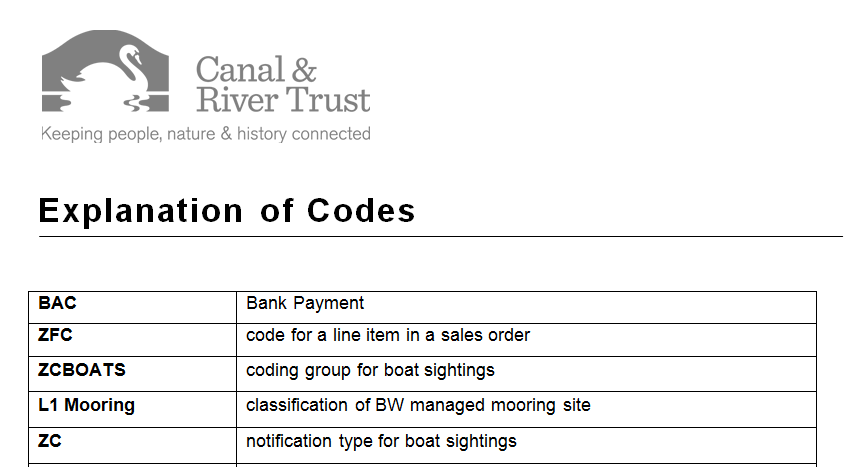
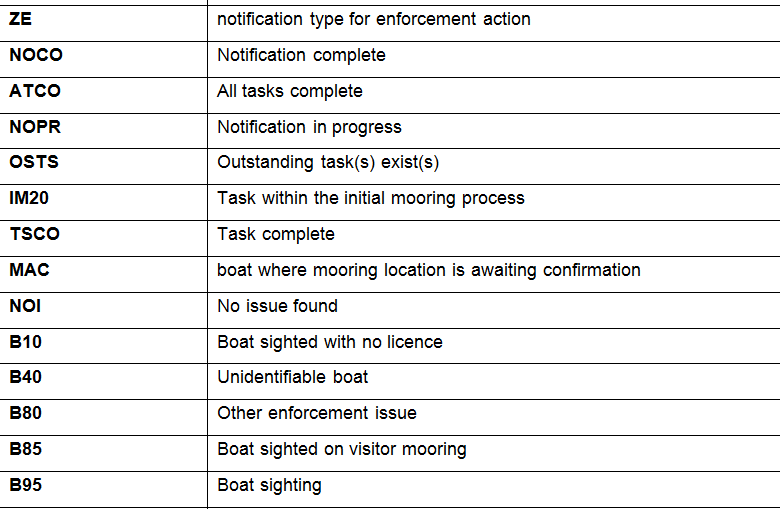
Below is the list of codes BW and now C&RT use for sightings and boat related issues:

Thursday, February 28, 2013

Have you been spotted?

How many times have you been spotted by a waterways patrol officer. Your boat details go into his handheld computer and your sighting is logged via GPS. If like us you just comply with the rules you hardly notice them as they walk or cycle along the towpath.
I did get wondering if they would give me a list for Nb Valerie and so tagged the request onto another e mail to CRT(canal,river trust). Just a few days to reply is very impressive.


The link to the list of sightings is                        The list of codes is

Not much listed in 2006/7 but I assume perhaps the boat checkers of today were not around then with perhaps just an area manager going out occasionally.

EDIT  Both links should now be working, they do for me although slow. Let me know if still a problem and I will try something else to link them. They open as Excel Web app

Tuesday, February 26, 2013

Marsworth

Pulling in at Marsworth for water and rubbish disposal the view had changed dramatically. Almost all the site had been cleared ahead of the builders erecting and I quote;
"12 new stunning dwellings and a sympathetic conversion of a historic building"
They make it sound like they are doing everyone a favour re the historic building but probably wished they had their way and replaced it with more housing had it not been for the planning people.
For now the services are the same but will according to the developers site be modernised with the addition of a pump out machine as an extra.

This is how it looked. To the rear was the old concrete post making factory and the remainder was a working yard for CRT. The building on the far left was used as an office and is the historic building they refer to.

Above some pictures from the developers site. My thanks to Jo on Hadar for the link to the site. The aerial view shows the Grand Union main line on the right and the Aylesbury arm going off to the left. It just won`t be the same but as is always the case we will get used to it.
Next will be the Bulbourne yard. Never I hear you say, it`s full of Grade ll listed buildings. Mmmmm maybe next post I will dig out a link that shows an artists impression with a fancy bridge and a CRT.......NO you need to see this now HERE.
Is nothing safe from the money grabbing developers.


Edit: Perhaps the above link is a little tame. Try this one and see the same Marsworth developer with their impressions of Bulborne.


Sunday, February 24, 2013

Seven heaven, seven years afloat

Seven years ago Nb Valerie made her maiden voyage from Winkwell in a snow blizzard. It could have been left for better weather but having moved aboard the decision to go on that particular day was to a boating virgin was not to be put off.

Below is a section of the blog post on that day.

entered Berkhampstead and dived into a pub "The Boat" and sat by the fire with 2 cups of hot coffee, yes i know pubs sell beer but we needed to have our wits about us on this our maiden voyage. Anyway fell out the pub 30mins later intoxicated by the warmth of the open fire and followed the ARGUS coal and diesel boat through the next lock, she was two abreast loaded with coal and soon stopped to service the needs of boats moored so we went past and decided to stop outside Waitrose for some nice crusty bread and use the cash machine.
Wish we hadn`t as when we came to caste off--nothing. Forwards backwards--nothing. Now remember this is the maiden voyage of 2 virgin boaters. So plenty of water movement when forward engaged so i thinks prop is revolving but just in case have a look down the weedhatch, ok be honest how many of you are laughing. Prop clear so i think are we aground, rocked the boat and it seemed fine so i phoned Phil the builder as he said phone and he will be with us if we get into bother- what us!-get in bother! You lot must be hysterical by now. Anyway he established on the phone after a few questions that we had run aground slightly at the very front end, but i knew that just testing him wasn`t i.
Off we go through the next
lock.................

So much water has flowed past the hull in those 7 years.  Hundreds, no thousands of locks plus who knows how many miles because the only records I keep are my memories. So many wonderful views as the miles slowly drift by. The many peaceful moorings sometimes just a mile or two away from  thousands of people living as I once did but you seem to be in the middle of nowhere. So many wonderful boaters who are like an extended family....I appreciate you all. I shared my adventures with hundreds of people along the way who just walked by the mooring and showed an interest in the life of a water gypsy.

Now I get to share all this with the most wonderful person that ever asked  about my life aboard my lovely wife Jaq. She first took interest with the words `Dear sir` LINK
 Her blog True love, first post HERE tells her story but be warned Jaq is a writer and this is a long read so maybe if you get into it bookmark it for a winter night read.

Friday, February 22, 2013

Spam attack, I surrender

Below is a screen snatch of the blogger page where comments await moderation by Jaq and I. There are 34 and they are all spam.
 The actual spam file contains Eighty+.  These have all been intercepted by


blogger but recently, well quite a few months actually, spam has been getting through to the above section that should be genuine comments. Spam in the right file is not a problem as one click deletes it all but in the above file we need to go through and pick out readers comments and publish them.
A lot of blogs use the moderation system pictured  left. Personally I hate it as I find the wording often difficult to interpret.
Anyway try your best to `type what you see` as we do enjoy your comments.

Tuesday, February 19, 2013

More Solar on the roof

A while back when I did the blog on the fans I mentioned something was being replaced on the boat. Yes the wind generator has gone and in it`s place I have installed a solar panel. It is rated at 245watts and although large (39"x 64") it still allows me to walk along the roof when I need to.
The wind generator worked ok if moored in the open with a decent wind but those occasions were not that frequent. It also took up the same space length wise and the wire supporting the pole was across the roof preventing the space being used. At least the panel will produce energy without wind and even if no visible sunshine. So no more wind power.

It is wired up to a 20amp Tracer 2215RN MPPT controller. Not sure of the amps going into the batteries as I have still to wire in a meter. I also have a 100watt panel that is wired to the old wind Genny controller and seeing the high battery readings on it tells me the new panel is working very well indeed. The panel sits in two pieces of angle (Green) and the four corner pieces (silver) will

allow the panel to be tilted in four directions. Although not able to be rotated to follow the sun I feel this was the easier option bearing in mind the size and weight of the panel. It will give significantly more power than being left flat.
Bye bye Sun you worked well today.

Saturday, February 16, 2013

Cruising Odds and Ends...

"A good traveler has no fixed plans and is not intent on arriving." ~ Laozi, Chinese Philosopher

   I realized I've been holding on to a bunch of pictures I wanted to use for a general post about living aboard, so here goes, a bit of Odds and Sods as they call it over here--or Odds and Ends as we say in the States!
The Admiral--before his morning tea and cookies!
A thin rime of ice on the water
    Most of our mornings begin with Les rising to check on the fire in the wood stove. He scrapes the ash of night away and adds some wood to bring up the heat for me. Then he comes back to bed for a snuggle. Usually we fall back into a light sleep and rise about thirty or forty minutes later. One of us puts the kettle on and we settle at the dinette for a morning cup of "qwuaffee" (coffee in a Brooklyn accent) for me, tea and biscuits for Les--yes folks, Les begins his day with cookies, not eggs and bacon!
                                                                After the Admiral finally wakes up and we get underway, there is always something amazing to see.
   Last week as we moved along there was a thin rime of ice on certain stretches of the canal as we made our way from Fenny Stratford to Old Lindslade to rendezvous with family. After mooring up we often stay
Our amphibian stowaway!
a few days to work on various boat related projects, or catch up with work (me), emails, and world events.
   All geared up to change the oil, Les popped the lid on the engine hold and discovered to his amusement, a stowaway! It was hunkered down in the compartment which catches drips from the stern gland (for non-boaters this is something that attaches to the prop shaft and comes inside the engine compartment.) Amazing isn't it, what hides in plain sight all around us!
   One afternoon we moored up in time to watch a mated pair of swans chasing away their juvenile! As we watched the young bird tried to get back in the canal and swim back to his parents but they refused to allow it. 
   Specifically the Cobb (dad) who fluffed out his wings in a threatening display, hissing and carrying on. The Pen followed in his wake. Their poor offspring was obviously confused as to why he had been fed, loved, protected and sheltered by his folks only to be suddenly set upon and driven out. 
   The juvenile with his patchy brown feathers not quite replaced by the glowing white ones of adulthood, stood on the towpath, head down, trying to find something to eat as he walked along, attempting to ignore the Cobb and Pen swimming alongside hissing. Eventually his folks started to swim away so Les took some bread out and tore it up for the young bird. He ate with head tucked downward, cleaning his feathers occasionally. 
   Suddenly his mom and dad figured out there was food to be had and swam quickly up--the Cobb hoisted himself out of the water, stuck out his chest, flapped his wings and dropped his head over his chest in the most alarming display of power as he marched down the towpath hissing at his offspring and us. This display changed my mind completely about the beauty of swans. 
Cobb and Pen with wings up and out
The juvenile attempts to eat before his parents come and take it all. Note their aggressive wing posture.


Here they come and Junior cowers near the hedge as his meal is eaten by dad.
Sorry it's blurry. The Cobb marching down the towpath hell bent for leather, intimidating his frightened offspring!
A close up of the juvenile with his brown feathers.
   In fairy-tales Swans are pictured as beautiful near mythical creatures with their white gliding bodies and curved necks. In reality they are mean spirited, territorial birds large enough to break a man's arm with their wings. They open their mouths and hiss like one of those aliens that popped out of people's chests in the movie by the same name. I am completely over my enchantment of swans after watching this sad display against their own offspring.
Sentinel crow
   I'd rather be a crow, which live in extended families and keep their offspring close for up to two years to be sure they are mature enough to fend for themselves and contribute to the colony. Every settlement of crows will have a sentinel posted. This one kept watch while we were moored nearby.
    We eventually settled in again for a few days below Slapton locks. It was just us and one other boat--and quite serene until a horn broke the morning quiet. A hunt was taking place across the field from where we were moored.
   We saw folks attired in the traditional black coats, as well as Gold coats which I assume are the colors of that particular Hunt club. The scarlet coats are now generally worn by the Master of the Hunt, the Master of the Dogs, or other Masters who have earned the appropriate number of buttons (usually 5) illustrating they have helped set up and run many hunts. 

   Since it is outlawed to actually hunt foxes in England (thank the Goddess), they are usually after a scent trail laid down by a member of the hunt prior to its beginning.
   The next morning we woke to sun! After a week of overcast weather with colder temperatures threatening to descend on us, it was a joy to see the sun...but wait, it's raining! It is sunny as all get out and it is raining! Ah well let's enjoy the rainbow shall we? Soon enough the storm clouds gather in and old Sol disappears as precipitation pours from the darkened sky! All in an hour's time. Time to stretch out in front of the fire with a good book. 
A hard rain falls at Slapton lock
   I found Keith Richards autobiography in one of seven charity shops we visited while in Leighton Buzzard earlier in the week. It came out in 2010 just after Les and I met.
   I heard Keith interviewed on Weekend Edition for NPR (National Public Radio) and I thought he was actually quite thoughtful and interesting. His book was on my list and I finally had it in hand for £1.50! I can say he did not disappoint as a writer. Richards' recall of everything--his early life growing up in Dartford, his grandfather's nurturing of his love of music, meeting Mick, starting the band and all the long road between then and now was faithfully portrayed in a very
Nature's watercolor
honest fashion--miraculous given his long term drug habit.
   I came late to an appreciation of The Rolling Stones' music. I only really discovered them about five years ago! I made a 2 disc set of their music from the very early days to the present and brought it with me from Cloudhouse.
   Another morning dawned overcast but warm--in the high forties Fahrenheit. I took a walk up to the next lock, helping two women out on a day boat through the locks. It was really encouraging to see signs of spring all around.
    Sweet green budlets are plumping up along winter weary stems; Lenten roses droop to the sodden ground, and the last rose hips of winter hang withered on the stalk. I looked for signs that Comfrey was up. Nettles of course are always there!
   Imagine my surprise and delight at finding this sign posted above a sweet patch of herb garden behind the bench at Slapton lock. What a thoughtful thing to do.
   I picked several sprigs of fresh, green rosemary to add to our favorite Potato dish and returned to NB Valerie and my best beloved Les, feeling refreshed and ready to dive into making dinner. We had a lovely Chicken Tarragon Pot Pie and the recipe is included at the end of this post for folks to try. This recipe came out of the Daily Mail Weekend and I tweaked it for my own tastes.
NB Valerie
   Today Les walked into a nearby village to score a Daily Mail Weekend paper for me, and I baked, at his request, a pan of orange cranberry rolls.
   The admiral spent the day splitting wood we scored from a downed tree while coming up Seabrook locks. Our wood box is full and the rest is stacked neatly under a tarp. 
   In my rooftop garden box fresh green shoots of chives are reaching upwards; parsley grows beside them with a pale yellow green fringe of new leaves, and my large pot of mint has developed runners over the winter which now have tiny green flags sprouting from each stem!
   Back inside we are warm, dry, cozy, and listening to the Stones as I write and Les reads in front of the fire. We do live the good life and I am so thankful to have my favorite Valentine with which to share it!

Chicken Tarragon Pot Pie 
 Serves 4
Pre-heat oven to gas mark 7/425 degrees F.
Ingredients:
2 T. olive oil
200 gr/7 oz. diced bacon or lardons
8 shallots peeled and cut in quarters
4 large garlic cloves, crushed and diced
2 T. fresh Tarragon, diced
25 gr/1 oz. butter
1 1/2 tsp. Beau Monde seasoning
3 T. flour
3 T. corn flour (corn starch)
250 ML/9 fluid oz. of Marsala wine
600 ML/1 pint of chicken broth, heated
4 large boneless, skinless chicken breasts, cut into bite size pieces
200 gr/7 oz. baby new potatoes, peeled and cut in half
300 gr/7 oz. of carrots, peeled and cut into chunky bite sizes
200 gr/7 oz. fresh mushroom, cleaned and sliced into chunky slices
125 gr/4.5 oz. fresh green beans, cleaned and cut in half
100 gr/3.5 oz. fresh petite pois peas (frozen are fine)
100 ML/3.5 fluid oz. double cream (I use evaporated canned milk which works fine. You could also try using Creme Fraiche)
1 sheet of frozen puff pastry, thawed, cold and ready to use
salt and pepper to taste

Instructions:
   Heat oil in a heavy bottomed dutch oven or deep sided saute pan. Gently cook the bacon until golden and crisp. Remove with a slotted spoon and set aside.
   Add shallots, crushed garlic, mushrooms, and butter to the pan and cook for 1-2 minutes on medium low until the shallot softens and the garlic gives up its perfume. Be careful not to overcook or use too high a flame, otherwise your garlic will turn bitter! The mushrooms should be lightly browned on the edges.
   Stir in 3 Tablespoons of flour and turn up the heat to medium. Cook for a minute or two to remove the raw taste of the flour, stirring all along.
   Slowly stir in the Marsala wine and heated chicken stock. Bring to a simmer as it thickens and add chicken, bacon, potatoes, carrots, and green beans. Cook for 20 minutes.
   Stir in the cream or canned evaporated milk, and season with Beau Monde, salt and pepper to taste. If you want your gravy thicker now is the time to take 3 Tablespoons of corn flour and mix with a little cold water to form a paste. Stir this into your pan and let it simmer while you stir. Your gravy will thicken right up.
   Why use flour previously and corn flour now? The flour used earlier in the recipe actually absorbs all the remaining bacon grease, olive oil, and butter and incorporates their flavor into the dish. I found corn flour (starch) used at this juncture gave my gravy the thickness I wanted.
   Add the peas and fresh Tarragon and stir through gently. Pour your casserole ingredients into whatever heavy casserole dish will stand up to the high oven heat.
   Top with a sheet of thawed puff pastry, cutting it to fit if you need to do so. Place in top rack of oven and set timer for 20 minutes. Turn pan when timer goes off and let it cook until your puff pastry is fully risen and crispy browned. 
   to serve, cut into the pastry top with a knife and remove a square to a place. Scoop out the contents underneath with a serving spoon and carefully place the cooked pastry on top. Serve!

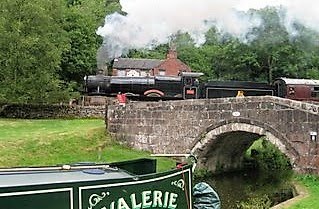
NB Valerie & Steam Train by Les Biggs

NB Valerie & Steam Train by Les Biggs