How to Leave a Comment on Our Blog

HOW TO LEAVE A COMMENT ON THIS BLOG
1. Scroll to the end of the post.
2. Click on the phrase "0 comments" or, if there are comments it will indicate how many, for example, "8 comments." Clicking on this will open the comment option for you.
3. Type in your note.
4. Choose your Profile. If you don't understand the choices under Profile then choose Anonymous but PLEASE type your name and location at the bottom of your comment so I know who you are!

Friday, May 11, 2012

The view from the galley

`Growing old aboard` was Jaq`s last blog post. I think growing old has now taken on a completely different meaning to when I lived aboard on my own. I used to think what will be will be take one day at a time and pity the poor bas...d that discovers my body when it all ends. Now I just want to be around for ever providing I can retain some Independence and not be a burden. Just 2 words, a ring and most of all the love of a good woman can change your outlook.
Ok so just me thinking aloud as I read through Jaq`s post.
She looked to be in her late seventies or very fit early eighties, with long white hair pulled up in a soft bun. Thins wisps escaped to curl around her face. She wore a blouse with a faded, small flowered print, and a pair of faded denim pedal pushers. Plain white sneakers graced a pair of small, agile feet. In her tanned, gnarled hands she held a small blue bowl half filled with berries.

Jaq has almost painted a picture with the use of some extra words. A talent learnt after 5 years of attending university whilst bringing up her 2 girls. Wonderful thing education it carries on till death, you never stop, however small, absorbing knowledge. Now while we cruise Jaq instructs beginning and advanced writing tutorials to students 5000miles away and I get a few tips on writing for free.

I would probably have wrote,

The old lady looked about seventy with long grey hair some hanging down the side of her face and wore white trainers and a blouse. Her wrinkled hands held a bowl with some berries in.

Anyway all the above just leaked out through my fingers as I read through Jaq`s blog and thought how happy my life is with Jaq.

Blog time.
At the moment we are on the Middlewich arm just killing time waiting for my dental appointment as I have a loose tooth. I found a dentist in Nantwich who was taking on NHS patients rather than seeking a private appointment. My reasoning being that as I have a fear of needles and my mouth being invaded by dental apparatus paying high fees for private treatment for a horrifying experience is stupid. Not sure how it will all go with regards to further appointments so we might poodle off to Chester after Wednesday`s appointment and do any follow ups on the way back.
We did go into Middlewich to go shopping and on the way out topped up the diesel and bought 2 bags of smokeless fuel. The diesel was 89p per litre by the way and the 2 bags of Taybrite £25($32.5). Now what is niggling me is the tax part of the transaction.

Taybrite......£10.50
20%............£ 3.99 Now 20% of £21 = £4.20 so not quite sure what has happened here other than their till being wrongly programmed. What annoys me is why do we not get the reduced rate of 5% for fuel. If you look at the HMRC page section 7.1 and 7.1.4 lists solid fuel as being taxed at the reduced rate but when you refer to section 3.2 you find amongst the qualifying list houseboat and without referring you here there and everywhere us narrow boaters are not classed as houseboats. Still at least the diesel was only 89p, motorists are paying £1.45.

The wind is strong and once again surprise surprise it`s raining. Do we care? No. The wind genny is putting in between 5-11 amps, the rain at the very least is washing the roof but more importantly it seems the reservoirs are filling albeit a very small amount.
BW has by extending opening times of lock flights eased restrictions at Stoke Breune, Buckby, Calcutt and Braunston due they say to "improved reservoir holdings"

So here we are moored up without a care in the world with no schedule to follow. I am blogging and reading and Jaq is at this moment standing in the galley making a Blueberry pie and gazing out over the River Weaver. The picture below is her view.

 The river flows in from the left and cows graze on the lush Green grass in the field that runs down to it  from the towpath. The river then runs away from the canal into the Flashes. The top flash we can see is a lake of about 12 acres and was formed after subsidence occurred following heavy Salt mining. From here the R. Weaver passes through more flashes and widens as it flows through Winsford and Northwich and into the Manchester Ship Canal and the River Mersey.


So just to finish this blog. If this is growing old aboard, long may it last. Good health and long life to you all afloat or land based.
Just about to hit `publish` and the boat is really being buffeted by the wind, so glad we are moored.


Monday, May 07, 2012

Growing Old Aboard

"Grow old along with me! The best is yet to be, the last of life, for which the first was made..." ~Robert Browning

   I was inspired by Del and Al's post titled Just living It on Derwent6. They said, "'This is a lovely life, but one question we always get asked is "What are you going to do when you get older?"'
   We returned from our wedding and the frenetic pitch of wrapping up my Stateside life in early September. NB Valerie was moored for the summer at Napton so we headed out for some countryside quiet, mooring up around bridge 101 on the North Oxford.
    Blackberries were in abundance and we were delighted by the opportunity to fill a bucket. As the two of us worked our way up the towpath picking fat, black berries, we met a woman berrying alone. A boat was moored nearby.
   She looked to be in her late seventies or very fit early eighties, with long white hair pulled up in a soft bun. Thins wisps escaped to curl around her face. She wore a blouse with a faded, small flowered print, and a pair of faded denim pedal pushers. Plain white sneakers graced a pair of small, agile feet. In her tanned, gnarled hands she held a small blue bowl half filled with berries.
   As we gathered berries together we conversed. She asked us how we came to be berrying on the towpath and we told her about our love story--how we met, fell in love, married, etc. etc. Her pale, blue eyes grew misty as she listened to Les. I asked her if she lived nearby. Her face folded into a lovely smile.
   "Yes," she replied. "I live right here." She turned and pointed to the boat moored nearby. Smoke curled from the stove pipe. The windows were hung with lace curtains, closed to the mid day sun. She no doubt noted the expression of surprise on my face.
   "My husband and I have lived on our boat for sixteen years. He is ill now with an incurable illness. He wants to die at home and I promised him he could. I will do whatever it takes to keep my promise."
   Her eyes look deep inside mine, searching for...something. Perhaps she thought I might be shocked by her declaration. She could not know that I have faced my own death more than once, in fact quite recently. I wondered if her husband's incurable illness might be the final stages of cancer. I stood in awe of her courage and love.
   "That's would be the way I would want to go--in my own bed, in my own home aboard," I said, and we wished her well. In the morning their boat had gone, moved on toward Braunston and her husband's final days...
   As the wheel of the year turned towards the longest night, Dear Sir steered us back up the Grand Union canal on our way north from a visit to London, with stops in Watford and Luton to visit family.
   We came in to Slapton locks in the waning light of a brittle, windy afternoon. A local boater on a permanent mooring stopped for a chat on tehway to his car.
    Garbed in baggy black jeans, he was wrapped in several warm layers including a large shapeless jacket, maroon knitted scarf tied close around his neck, and a black knitted cap. His face wore a hungry, curious expression under the grizzle of a three day growth of beard. 
   Those big double locks on the Grand Union take a while to fill. In the course of the conversation regarding whether or not the coming winter would be as severe as the two just past, the bloke mentioned that his nearest neighbor on the next mooring was a woman in her nineties, confined to a wheel chair. Her sixty seven year old son lived aboard and looked after her. She found it easy to get about on the boat since the narrowness allowed her to reach out and hold on to something on each side.
    "Last winter at the holidays, the ice was thick on the frozen canal and the lock gates were quite slippery with ice. Usually," he said, "the son carries his mum over the lock gates and I get her chair for her. They go home to family each Christmas for two weeks, but last year it was too dangerous to walk across the lock gates so we towed her in her wheelchair across the ice!" The bloke's friendly brown eyes crinkled at the corners as his laughter echoed in the cold, crisp air...
   Winter's dark, short days came and went as we cruised through them. At Braunston we came across a lovely couple in their mid-seventies, headed out for the bus into town.
   They were a dapper dressed pair; he in pressed black trousers and a warm fleece coat, his wife in dark plaid wool slacks with a mauve jacket. Her hair was nicely styled, earrings dangling from each ear. She hooked her arm through his as he walked along with a cane.
   They knew Les in passing as a fellow boater and stopped to say hello. She had a Scottish accent and sharp eyes that didn't miss a thing. Her husband had a small, neatly trimmed moustache which framed a lively smile as they said hello. They were on their way to a follow up doctor's appointment for his leg which had undergone recent surgery.
   Dear Sir introduced us, offering a brief synopsis of where he had been and why he hadn't been about on the cut much for the past year! After they offered congratulations on our marriage, I asked if they lived aboard their boat NB Relaine.
   "Oh yes," she assured me. "We've lived aboard as continuous cruisers for twenty six years now." We talked briefly about all the changes they had seen and how much they loved their lives aboard. We said our goodbyes as she slipped her gloved hand through her husband's arm and off they went.
   I must admit I found myself envious of them. Oh! To have been living on the cut all that time! It just goes to show one can age well in life aboard a boat on the cut. I think the lifestyle lends itself to longevity with the lack of stress and slow pace of a very simple life.

Sunday, May 06, 2012

Snippets from my photo album

 Still walking the footpaths around Bettisfield i came across the building below and along the tree planted walkways around the grounds I came across the statue pictured on the right. After a chat with a lady walking nearby I learnt the building and grounds were a Buddhist retreat for women called Taraloka.


The strange looking buildings on the right were located at a camping site next to Valle Crucis Abbey or at least the remains that date back to 1201. I will leave Jaq to do one of her picture blogs on the Abbey and will only say we spent a long time satisfying her love of the history in the UK.
Camping Pods are what the Abbey Farm site calls them, "no need for a tent" they brag. Well I think they should change that to "bring your dog, no need for a kennel". I did take a picture through the glass to show you how small they are but the website HERE will show the tiny interior. The sleeping bags are the actual length of the kennels pods and the prices quoted for the different groups must be for more than 1 Pod because how you could fit 3 adults or 2 adults and 3 children in there I no not.
I wonder  who Ivan was. His life of 61 years did i hope include a lot of boating.                           The memorial was on a rocky ledge on a tight bend (pic right) going in to Llangollen. 

Friday, May 04, 2012

Marbury: Medicine for Body & Soul

"And did those feet in ancient time, Walk upon England’s mountains green?
And
was the holy Lamb of God on England’s pleasant pastures seen...in England's green and pleasant land." ~William Blake


On our way up to Llangollen we stopped for the day just past Marbury lock. It was pouring rain. We brought a load of wood and coal inside, made some tea, and settled down to wait it out.

We didn’t wait long, and after the lull of the fire it was refreshing to walk, hand in hand through the misty spring time weather along small country lanes. I was excited because nature was just unfurling its green spring banner and as a medicinal herbalist I stop every few feet to examine local plant life as we walk along. Dear Sir has taken this excursion previously and he knows the beauty that awaits me…
NB Valerie on Llangollen near Marbury
As we walked down the lane towards Marbury village I looked back to see this view of NB Valerie. It looks like a fey landscape with lace trees! This photo hasn't been changed--this is exactly as I took the picture.


Tall hedges and narrow lanes-Marbury
This is a typical British village lane: narrow and winding, with tall hedges on either side. The air was crisp and clean; soft, clean, rain, fresh grass, and that elusive bright green, slightly sweet, liquorice scent filled my nose and made me feel thrilled to be alive for another spring. White Thorn or Sloe is flowering throughout the hedges, and puddles call to the child in me for a splash or two.


teh one lane road to Marbury with a passing place to the right and Les
Les serves as a visual measurement for the width of this lane. To the right is a passing place! What un-nerves me is how the locals tear down these narrow streets at break neck speed.


Dock leaves
Dock has a beneficial effect on bile production and is known as a valuable remedy in treating skin eruptions. Its high iron content makes it a good remedy for anemia.

Dock is a medicinal plant known in antiquity for its laxative effect. Centuries later in Anglo-Saxon England physicians used a mixture of Dock leaves, other herbs, ale, and holy water to cure people believed to have been struck by witchcraft with “elf sickness.” Common folklore holds that dock leaves will alleviate the sting of nettles. One often sees them growing side-by-side in fields. The root yields a yellow dye.


looking down the lane in marbury passed the old factory to teh lake
The village lane curves ‘round and downward to a small lake framed by on old oak. Marbury has been settled since at least 1200 BCE. It was mentioned in the Domesday Book of 1066 as having seven inhabitants. In 1551 sixteen villagers died of “sweating sickness”—most likely Influenza. Today the number of folks living in Marbury has grown to two hundred.


018
17th century two story outhouses on the left. These were not toilets—they were farm buildings. Marbury is dairy country. Cheese making was an important source of income in here beginning in the 19th century hence the thick clusters of cleavers fringing the lanes; by 1951 this artisanal craft died out.

Local history records that by 1850, nearly all local tradespeople were involved with agriculture, whether directly or indirectly. At that date, Marbury had two blacksmiths, butchers and shoemakers, and a wheelwright; later there was also a smithy, coal merchant, tailor, bake house and one or more grocer's shops. Today these thriving business are in the past. The center of this village is a natural conservation area.

Follow the lane around to the Swan pub, below, which has been integral to village life since the 1765.
swann inn 2
Directly across the lane from The Swan is a park with a fine view of the small mere (Welsh for lake)…


The mere across form teh swann Inn
…and the perfect seat under an old, gnarled oak planted in 1814, on which to sit and watch for birds on the water, or maybe doze in the afternoon sun while keeping one eye open for the locals coming and going from the pub!


old factory now flats marbury
Turn back up the lane the way we came and directly across the street from the old outhouses are beautifully restored buildings from the 1600’s--still lived in. The original inhabitants would have been eye witnesses to the English Civil War in 1642.


Cottage with heart on door
This cottage wears its heart on the door…


019
while this one makes a bold statement with a red entry!


periwinkle
Periwinkle is used in these postage stamp gardens as a ground cover. Vinca Minor is a hybrid of a Madagascan flower, Vinca Rosacea. It is poisonous and today it is used medicinally to manufacture Vincristine—a cancer chemotherapy drug.


Oregon Grape close up
Another popular plant in Marbury’s bijou plots is Oregon Grape Root (Mahonia Aquafolium)! I am astonished to find it so far from its natural home—Eastern Washington and Oregon. It is typically used as a hedging plant, growing to six feet tall over a period of years. It has sharp, pointed, leathery green leaves similar to Holly.

In spring it forms clusters of bright yellow flowers beloved by bees, followed by dark blue berries. Most folks have no idea that this is a very potent and vitally important medicinal plant. It is the three year old roots that are used to make a decoction which will kill viral illnesses like Influenza. Oregon Grape contains immune boosting, infection fighting Berberine. The whole root contains tannins that ease inflammation, irritation, and itching of the skin.

It has a considerable reputation as a blood purifier, cleansing the tissues and blood of toxins and waste products. Its bitter components stimulate the liver and gall bladder, and are tonic to the digestion with a mild laxative effect. (Caution: this plant should never be used during pregnancy.)

To make a decoction, dig the root up and divide it in year three. Take a healthy bit of teh root and wash it thoroughly. Towel dry and chop it into pea sized pieces with a very sharp knife. Add one ounce of Oregon Grape root to 4 cups of clean, cold water in a non-metal pan with a lid. Bring quickly to a boil.

Once the water is boiling, set the pan on another burner turned as low as it can go. Simmer very gently for 60 minutes. Don’t open the lid or you will lose beneficial alkaloids in the steam.

Remove from all heat and allow to cool for two hours. Pour all ingredients into a clean quart jar and cap it off. allow it to sit for 12 hours. Strain the plant material out and keep the liquid.  This will only keep for about two days refrigerated. You can add one fourth cup of brandy to it to help it last longer. Drink a quarter cup two times a day until the decoction is gone.


The church tower Marbury
Les pointed out the tower of St. Michael and all Saints Anglican church as we walked along…


Walkingup the lane to Marbury church
Dear Sir walked ahead of me while I stood, enthralled by the beauty of the mist clouded view. The only sound was that of a light wind ruffling the grass and bushes with a birdsong chorus accompaniment. There were no other people, no cars, engines, planes, or anything to indicate we were in the 21st century. I could just as easily have been standing in the 14th century!

Marbury church form teh road
The entrance to the churchyard is through a lych gate. The word lych comes from the old Saxon word meaning corpse. In the Middle Ages bodies were buried in shrouds not coffins. The shroud-covered body was carried into the lych gate and laid on a bier where the priest said the first part of the mass for the dead under the roofed gate.

The lychgate of Saint Michael’s was built in 1919 and is dedicated to those who served and died in World War I. It is inscribed, “Ye who live on mid English pastures green, remember us, and think what might have been.”


Marbury church with tombstones
Inside the cemetery facing the front of this Sandstone edifice built in the 1400’s.


faces in stone and churchyard niches
Dear Sir led me around the side of the church to the back, a smile of anticipation on his face…


a peacefulcorner of the churchyards
…as I looked upon a vista of green fields enclosed by low rock walls…


stone wall encloses sheep in hte field
…and the village lane winding off into the distance.


the mere in teh back of the church
I gasped in amazement as another mere appeared behind the church…


The mere by the church 1
….beyond the low rock wall and the gravestones.


the  back of Marbury church
Les checked out the gargoyle faces carved from Sandstone as we stepped inside the church doors.


looking thorugh the church door
The wonder and simple majesty of hand carved stone and wood took my breath away.


Looking toward the stained glass windows
I was quitely speechless with marvel at the history of centuries in which humans have walked, knelt, prayed, rejoiced, and suffered within these walls.


here lie the reaminsof Deborah wife os Samuel  1780
In the floor, a tombstone worn smooth in places by the footseps of two huundred years says, “Here lies Deborah, the wife of Samuel…who departed this life June 27th 1780, aged 40 years.


047
Nothing prepares one for eternity like the interior of a 14th century church built by the un-named craftsmen without the use of modern tools, still standing and still used for worship, weddings, christenings and funerals.


organ pipes
This splendid organ takes pride of place up behind the pulpit, adjacent to the choir stalls.


050
This dark and mysterious cove in the belfry holds the cords for the church bells! One seldom gets to see this part of an old church. On the walls all around are plaques dedicated to those who still support their parish and its people many hundreds of years after they were laid to rest:


mary EAton plaque 1731
The above dated alms for the poor are from 1731; the plaque below…


charity for the elderly of hte parish 1839
…honors Mrs. Elizabeth Wright who gave in trust £100 in 1839, the interest of which is given yearly to all parishioners of Saint Michael’s who reach the age of seventy years, in equal shares.


beautiful wood pulpit
This beautifully hand carved pulpit dates to 1456.


1530 vicker Henry Dickonson
The list of Vicars begins in 1530 with Henry Dickonson and lists 43 names up to the present day. Parish records indicate John Talbot, Rector of Saint Michael's beginning in 1564, was paid a stipend of forty pounds, six shillings and eight pence a year. (I’m not quite sure what the difference is between a Rector and a Vicar. Both serve the Anglican church as priests and have paid positions as clergy.)


A window in memorium
This beautiful window was given in memoriam to the church in 1837.

Tithes of the parish in 1839- each dweller in the parish was assessed and paid tax to the vicar as follows: for owning 1 cow and calf-1 and half pence; 1 barren cow,one pence and one shilling; beehives-one shilling and one pence; 1 cockerel-2 eggs; 1 hen-1 egg; every master, mistress, child or servant over the age of 16 years-2 pence each; under 16 but over the age of 7- 1/2 pence each.


Teh interior church door
Pensively I reached the solid wooden church door, and stepped back outside into the 21st century. How many souls have stepped through this doorway before me?


close up of teh back of the church and the doorway
Outside I considered the eternal view of those who are buried here in the churchyard overlooking the mere…


graves overlooking the mere
…it brings to mind the words “How lovely is thy dwelling place,” of Brahms requiem from Psalm 84.


misty hills and gracestones
The clouds and mist over the mere frame the stunning view rather than detract from the visit. The rain has come and gone leaving the world quiet and clean…


someone's stone book is being returned to dust
…while nature reclaims someone’s book of life.


The crooked church tower
The bell tower of Saint Michael’s is 63 feet tall and leans 25 inches from vertical. It contains a peal of 6 bells which were given to the parish in 1719. “These bells have rung out their message of joy and sorrow, war and peace for over 200 years and still ring.”


stone cutters marks 1
These are the marks of the original stone cutters, made by human hands…


modern stone cut by machine
….and this is an example of machine cut stone where the front wall has been repaired. It does the job but lacks the mark of humanity that makes this old church so touching….


Marbury church with tombstones
…and timeless.


graves overlooking the mere
The front walk through the graveyard, with the mere beyond…


across the front graveyard to teh churchtower
…and looking back at the church. I was stunned by the atmosphere created by the weather. It could easily have been 1535…


The church tower
As we walked away I was filled with peace, and the pleasure of Les sharing the beauty of the the mere of Saint Michael’s with me.


rainwashed lane back to the boat Marbury
On the road back home to the boat I was reminded of Local author Beatrice Tunstall who described the village in 1948 as "far from the madding crowd", and praised the "ancient lanes, deep trodden by the feet of endless generation, flower fringed amid the woodlands, with great hedges where honeysuckle and wild roses riot." (Local History Group & Latham, p. 10)


1 canal, goose and hedgerow
Back on board NB Valerie, our view out the dinette window: a lone white goose patrolling in a green field, bordered in the distance by the hedgerow blooming with white thorn, along the lane we walked to Marbury and back.

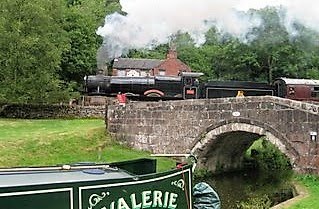
NB Valerie & Steam Train by Les Biggs

NB Valerie & Steam Train by Les Biggs